Source: Fortune
Summary
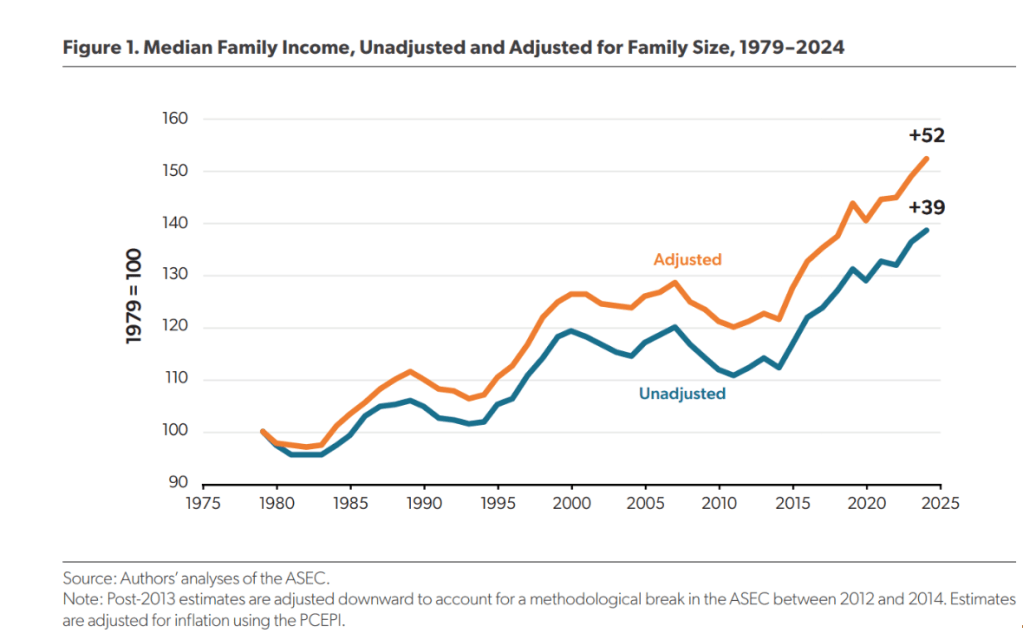
A recent report from the American Enterprise Institute (AEI) suggests that the middle class has not shrunk due to economic decline, but rather because many Americans have moved up to the upper-middle class. The report defines the upper-middle class as families earning between $133,000 and $400,000 annually. However, critics argue that the report’s methodology has blind spots, ignoring wealth, debt, and geographic reality. The article suggests that the perception of economic identity is shaped by social media and the algorithmic curation of wealth, leading to a sense of discontent among the upper-middle class.
Our Reading
The numbers tell one story.
The AEI report’s findings are based on income data, but critics argue that wealth and geographic reality are also important factors. The report’s authors, Stephen Rose and Scott Winship, acknowledge that wealth is a more complex measure of wellbeing. Nick Maggiulli, chief operating officer at Ritholtz Wealth Management, notes that the economy wasn’t built to handle the current number of people with high incomes. The article suggests that the upper-middle class is experiencing a sense of discontent due to the flood of competition in the markets for housing, education, and luxury amenities.
The strategy enters a familiar phase.
The article highlights the shift in the definition of what it means to be “wealthy” and how social media has replaced local benchmarks with an infinite scroll of curated wealth. The algorithm shows people who make their lives look small, creating a perceptual distortion. The article concludes that the middle class is not dying, but Americans have lost the ability to see their own prosperity clearly.
One original observation: The upper-middle class is discovering that success at scale creates its own form of scarcity.
Author: Evan Null