Source: Fortune
Summary
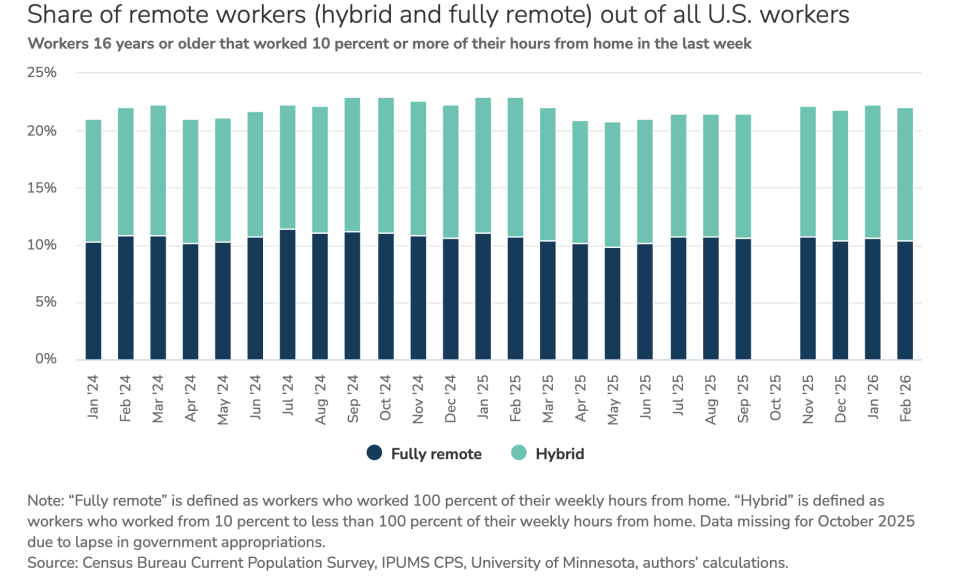
Despite predictions that remote work would decline, data from the Census Bureau and Federal Reserve Bank of Minneapolis shows that nearly 22% of U.S. workers still worked from home at least part of the time in 2025, with the trend continuing into 2026. Companies like Amazon and JPMorgan have ordered employees back to the office, but many workers remain unconvinced of the need to be in the office every day. Research suggests that remote work may not be a catch-all solution, but some employers see it as a competitive advantage.
Our Reading
The numbers tell one story. Amazon and JPMorgan may have ordered employees back to the office, but the data shows that remote work remains a significant part of the American workplace. Kyle de Bruin, managing director at Leesman, notes that only 3% of large companies are fully in office five days a week. Deborah Saneman, CEO of Würk, sees remote work as a competitive advantage, with her company attracting a growing pool of workers and achieving a better work-life balance.
The announcement sounds familiar. Companies are still trying to figure out how to balance the benefits of remote work with the need for in-person collaboration. The data suggests that mandates alone are not enough to sustain a return to the office. Instead, employers are focusing on deliberate communication and mentorship to make remote work successful.
The strategy enters a familiar phase. As companies navigate the challenges of remote work, they are also confronting the potential drawbacks, including a rise in youth unemployment. But for now, remote work remains a key part of the American workplace.
Author: Evan Null