Source: Fortune
Summary
A Fortune article discusses the growing divide between the top 20% of U.S. households, which drive most consumer spending, and the middle class, which is facing a severe margin collapse. In July, the household margin fell below zero, with wages growing slower than inflation. Consumers are increasingly relying on Buy Now, Pay Later services to bridge the gap. U.S. companies and policymakers are criticized for favoring the affluent, while IKEA is highlighted as a model for affordability and long-term economic resilience.
Our Reading
The numbers tell one story.
Top 20% households drive 60% of spending. Middle class faces 115% margin collapse. Wages grew 3.2%, prices 3.4%. BNPL usage doubled. Corporations target affluent, cut middle-tier jobs. Tax relief favors higher-income households. IKEA prioritizes affordability over revenue. Price cuts boosted store visits and operating income. Supply chain relocalization reduced costs. Energy investments cut volatility. AI retrained employees, boosted sales. Economic resilience requires volume, not extraction. Structural equity adds $3.1 trillion to the economy.
True success is not about extracting from a squeezed middle, but building systems that keep essentials affordable.
Author: Evan Null
The False Playbook: Extracting from a zero-margin base
Faced with a squeezed consumer base, a growing number of U.S. companies are responding by moving away from the middle class and tailoring their offerings to the affluent, passing inflationary pressures on to the end user. They are doing this while simultaneously utilizing artificial intelligence to protect their own margins. Employers are freezing or cutting hiring, with the steepest declines concentrated in middle- and entry-level roles, effectively constraining household earnings exactly when energy and living costs are surging. Washington has tried to address this structural crisis with tax relief, but the relief is uneven. The highly anticipated “One Big Beautiful Bill Act” (OBBBA) promised broad-based tax relief for the middle class. In reality, households in the 95th to 99th income percentiles will receive roughly 1.9 times the tax relief of middle-income households. Extracting the last dollar from a negative-margin consumer, or relying on tax relief that disproportionately benefits higher-income households, isn’t a long-term economic strategy. By engineering out the middle class, U.S. companies and policymakers are weakening their own demand redundancy. If the stock market corrects and the top 20% pulls back on discretionary spending, a diminished middle class leaves the economy with a weaker floor to fall back on.
The IKEA masterclass: Engineering affordability
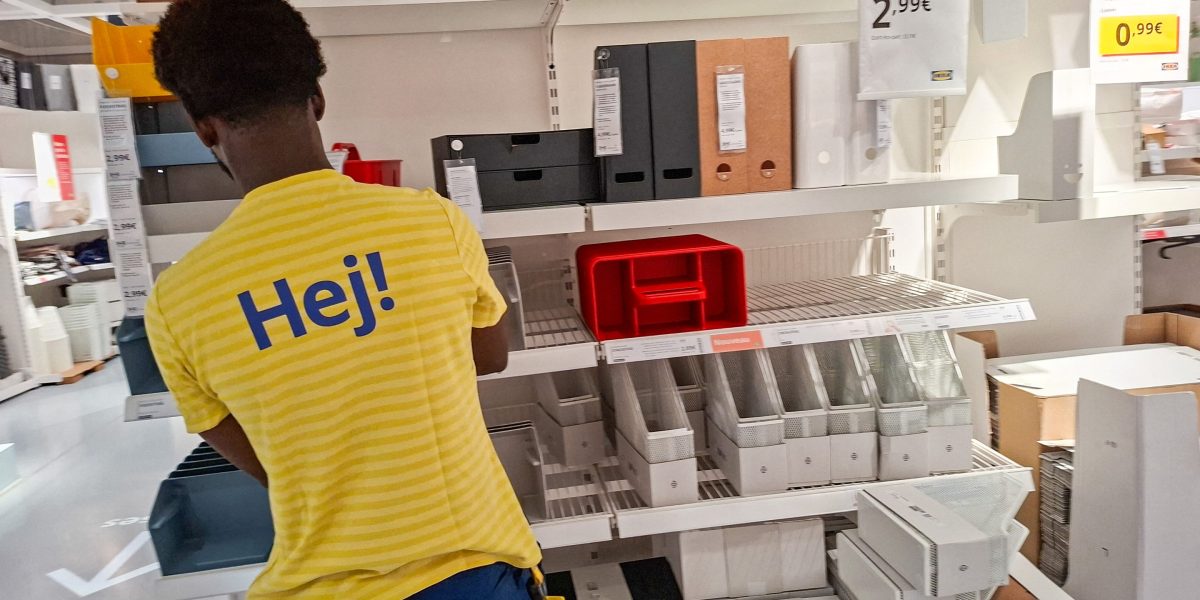
If the U.S. playbook relies on extracting from the few, IKEA offers a masterclass in optimizing for the many. When asked whether IKEA was pivoting to target the growing cohort of affluent Americans, Juvencio Maeztu, CEO of Ingka Group, pointed to a different measure of success: “I like to say that for us, the big KPI is not top line in revenue… The big KPI is in how many homes we are present.” He added: “We have a say normally that we sell umbrellas in IKEA, and we normally reduce the price of the umbrella when it’s actually raining.” IKEA is not doing this for charity. They are ruthless, brilliant corporate strategists building a durable moat for the 2026 economy. They achieve this through four structural pillars: Deflationary Pricing, Supply Chain Sovereignty, Energy as a Fixed Asset, and Human Capital Reinvestment.
Rebuilding the economic moat
IKEA treats its business the way we need to treat the United States economy. Maeztu noted that IKEA’s founder instructed them to “think 200 years out.” Washington, by contrast, rarely operates on that time horizon. You cannot fund 75-year national liabilities, like Social Security, or a projected $2.1 trillion annual federal deficit, on a barbell economy. A nation cannot pay its debts with a consumer base increasingly reliant on subprime credit. National solvency requires volume. If we want to build a resilient economic moat, we must build our economic systems around the second economy. And to do that, we have to be honest about who comprises it. The individuals bearing the brunt of this -0.2% margin collapse are disproportionately women and people of color. When Native American women earn 53 cents for every dollar paid to white, non-Hispanic men, and 510,000 Black women disappear from the labor force in five months, the economy’s floor is weakening. These are not only demographic statistics; they represent a structural misallocation of human capital.
Rebuilding the economic moat
Achieving an equitable labor market isn’t a social initiative; it is an economic stabilization tool. Closing these gaps would add an estimated $3.1 trillion to the U.S. economy. Let’s look at the math. Closing the pay gap alone expands the payroll tax base enough to cover one-third of the Social Security funding shortfall. Scaling that to close the broader equity gap generates enough economic growth to cover the annual interest on our national debt. True economic success in 2026 isn’t about extracting the last dollar from a negative-margin middle class. It is about strategic affordability and structural investment. IKEA proves that optimizing for the many is one of the strongest hedges against instability. You don’t survive the future by pricing out the middle class. You survive it by designing systems that keep the umbrellas affordable when it rains.
Rebuilding the economic moat
The article concludes with a call to action for U.S. companies and policymakers to rethink their approach to economic resilience. Rather than focusing on short-term gains and extracting value from a struggling middle class, the piece argues for a long-term strategy that prioritizes affordability and structural investment. By learning from models like IKEA, which has successfully navigated economic challenges through strategic pricing, supply chain optimization, and employee retraining, the U.S. can build a more resilient and inclusive economy. The piece emphasizes that true economic success is not measured by short-term profits, but by the ability to sustain growth and stability over the long term. It calls for a shift in perspective, from extracting value to creating value, and from short-term gains to long-term planning.