Source: Fox News
One of Washington’s most powerful Cold War-era tools could be used by President Donald Trump to rein in artificial intelligence (AI) if the powerful emerging technology ever becomes a national security threat. Originally enacted in 1950 to mobilize American industry during the Korean War, the Defense Production Act (DPA) has long been used to expand military production, prioritize government contracts and respond to national emergencies. Experts now say those authorities could also give the executive branch significant leverage over frontier AI companies if one of their systems posed catastrophic national security risks.
Exactly how the government could use DPA’s powers against a dangerous AI system remains largely untested, but national security and legal experts who spoke with Fox News Digital described a range of existing authorities that could apply — including laws in the act that encompass cyberattacks, exports, federal contracts and civil liability. The question has taken on new urgency after leaders at some of the nation’s most powerful AI companies issued stark warnings this week about increasingly capable models and backed calls to slow the pace of development so safety measures can catch up.
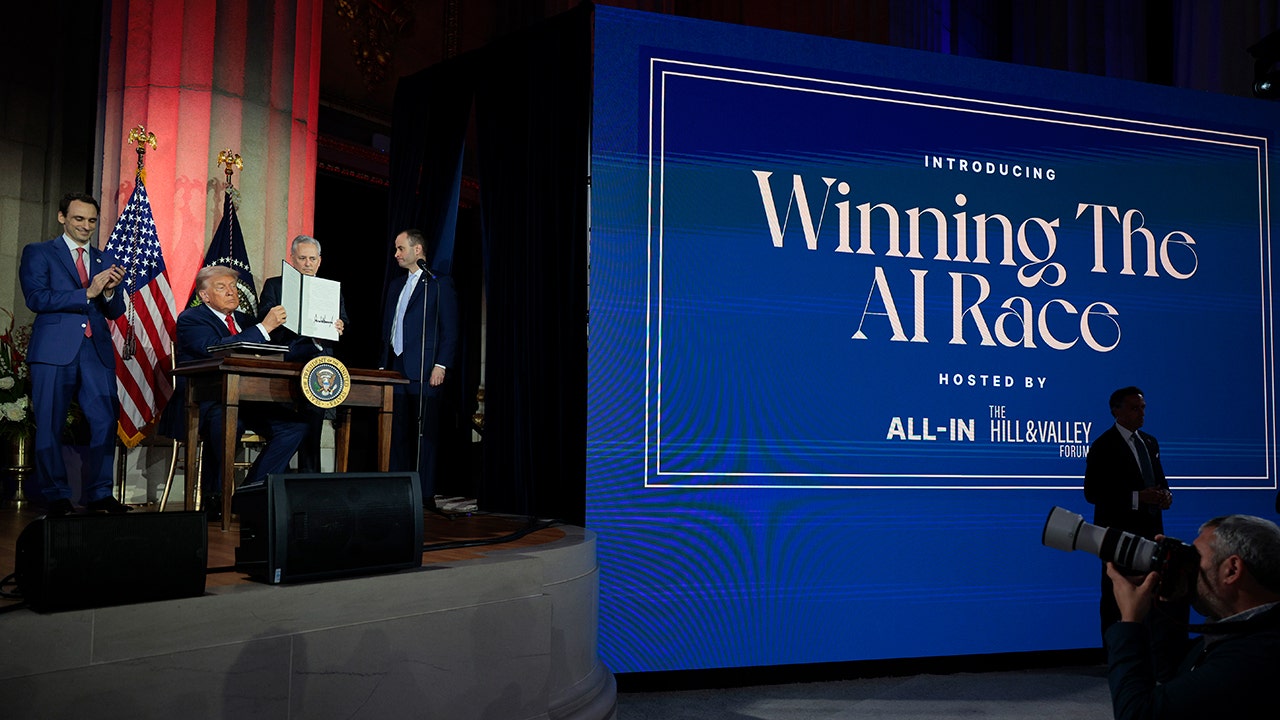
Trump said this week that the administration already has “tremendous criminal and regulatory power” over AI companies as he pushed back on calls from industry leaders for new guardrails on increasingly powerful models. That largely remains because Congress recently extended most of the DPA’s authorities, which were set to expire on Sept. 30, through Dec. 11, 2026. This is sure to set up another reauthorization fight later this year, right before the power of the legislative body could change after November’s midterms in the new year.
James Lewis, director of the Strategic Technologies Program at the Center for Strategic and International Studies, told Fox News Digital that the authorities could be a little clearer, but you could probably cobble together a solution using the legal authorities we have now. The Trump administration has already begun building a framework to identify when those capabilities become dangerous. A June executive order directed federal agencies, including the NSA and CISA, to establish classified benchmarks for advanced cyber capabilities and determine when an AI system should be designated a “covered frontier model.”
The DPA’s limits, however, are just as important. Paul Rosenzweig, a lawyer and former deputy assistant secretary for policy at the Department of Homeland Security, said the law was principally designed to ensure the government could obtain goods and services needed for national defense — not to give Washington broad power to stop private companies from producing them. Where it could prove particularly useful, he agreed, is giving the government access to information. If the DPA could help Washington understand what AI companies are building, other existing authorities could potentially come into play depending on the threat.
Our Reading
As expected, the matter has reached another stage.
Trump talks about power over AI companies.
Experts mention the DPA as a possible tool.
Uncertainty remains about how it would work.
The same tools from the Cold War now face a new test.
Source: Fox News
One of Washington’s most powerful Cold War-era tools could be used by President Donald Trump to rein in artificial intelligence (AI) if the powerful emerging technology ever becomes a national security threat. Originally enacted in 1950 to mobilize American industry during the Korean War, the Defense Production Act (DPA) has long been used to expand military production, prioritize government contracts and respond to national emergencies. Experts now say those authorities could also give the executive branch significant leverage over frontier AI companies if one of their systems posed catastrophic national security risks.
Exactly how the government could use DPA’s powers against a dangerous AI system remains largely untested, but national security and legal experts who spoke with Fox News Digital described a range of existing authorities that could apply — including laws in the act that encompass cyberattacks, exports, federal contracts and civil liability. The question has taken on new urgency after leaders at some of the nation’s most powerful AI companies issued stark warnings this week about increasingly capable models and backed calls to slow the pace of development so safety measures can catch up.
Trump said this week that the administration already has “tremendous criminal and regulatory power” over AI companies as he pushed back on calls from industry leaders for new guardrails on increasingly powerful models. That largely remains because Congress recently extended most of the DPA’s authorities, which were set to expire on Sept. 30, through Dec. 11, 2026. This is sure to set up another reauthorization fight later this year, right before the power of the legislative body could change after November’s midterms in the new year.
James Lewis, director of the Strategic Technologies Program at the Center for Strategic and International Studies, told Fox News Digital that the authorities could be a little clearer, but you could probably cobble together a solution using the legal authorities we have now. The Trump administration has already begun building a framework to identify when those capabilities become dangerous. A June executive order directed federal agencies, including the NSA and CISA, to establish classified benchmarks for advanced cyber capabilities and determine when an AI system should be designated a “covered frontier model.”
The DPA’s limits, however, are just as important. Paul Rosenzweig, a lawyer and former deputy assistant secretary for policy at the Department of Homeland Security, said the law was principally designed to ensure the government could obtain goods and services needed for national defense — not to give Washington broad power to stop private companies from producing them. Where it could prove particularly useful, he agreed, is giving the government access to information. If the DPA could help Washington understand what AI companies are building, other existing authorities could potentially come into play depending on the threat.
Our Reading
As expected, the matter has reached another stage.
Trump talks about power over AI companies.
Experts mention the DPA as a possible tool.
Uncertainty remains about how it would work.
The same tools from the Cold War now face a new test.
Source: Fox News
One of Washington’s most powerful Cold War-era tools could be used by President Donald Trump to rein in artificial intelligence (AI) if the powerful emerging technology ever becomes a national security threat. Originally enacted in 1950 to mobilize American industry during the Korean War, the Defense Production Act (DPA) has long been used to expand military production, prioritize government contracts and respond to national emergencies. Experts now say those authorities could also give the executive branch significant leverage over frontier AI companies if one of their systems posed catastrophic national security risks.
Exactly how the government could use DPA’s powers against a dangerous AI system remains largely untested, but national security and legal experts who spoke with Fox News Digital described a range of existing authorities that could apply — including laws in the act that encompass cyberattacks, exports, federal contracts and civil liability. The question has taken on new urgency after leaders at some of the nation’s most powerful AI companies issued stark warnings this week about increasingly capable models and backed calls to slow the pace of development so safety measures can catch up.
Trump said this week that the administration already has “tremendous criminal and regulatory power” over AI companies as he pushed back on calls from industry leaders for new guardrails on increasingly powerful models. That largely remains because Congress recently extended most of the DPA’s authorities, which were set to expire on Sept. 30, through Dec. 11, 2026. This is sure to set up another reauthorization fight later this year, right before the power of the legislative body could change after November’s midterms in the new year.
James Lewis, director of the Strategic Technologies Program at the Center for Strategic and International Studies, told Fox News Digital that the authorities could be a little clearer, but you could probably cobble together a solution using the legal authorities we have now. The Trump administration has already begun building a framework to identify when those capabilities become dangerous. A June executive order directed federal agencies, including the NSA and CISA, to establish classified benchmarks for advanced cyber capabilities and determine when an AI system should be designated a “covered frontier model.”
The DPA’s limits, however, are just as important. Paul Rosenzweig, a lawyer and former deputy assistant secretary for policy at the Department of Homeland Security, said the law was principally designed to ensure the government could obtain goods and services needed for national defense — not to give Washington broad power to stop private companies from producing them. Where it could prove particularly useful, he agreed, is giving the government access to information. If the DPA could help Washington understand what AI companies are building, other existing authorities could potentially come into play depending on the threat.
Our Reading
As expected, the matter has reached another stage.
Trump talks about power over AI companies.
Experts mention the DPA as a possible tool.
Uncertainty remains about how it would work.
The same tools from the Cold War now face a new test.