Source: Fortune.com
Summary
Standard Chartered China CEO Jean Lu said the yuan is unlikely to replace the U.S. dollar as a global reserve currency in her lifetime. She noted that while the yuan has limited potential against the yen or pound, it faces challenges due to restricted liquidity and capital controls. Despite efforts by the Chinese government to expand the yuan’s role, the dollar remains dominant, holding 57% of global reserves in Q1 2026. The People’s Bank of China is working to increase the yuan’s international use through offshore clearing banks and new financial mechanisms.
Our Reading
The numbers tell one story.
Lu says yuan can’t beat dollar.
Beijing pushes for more use.
Reserves still favor dollar.
Yuan’s growth is slow but steady.
Author: Evan Null
Yuan’s Global Ambitions
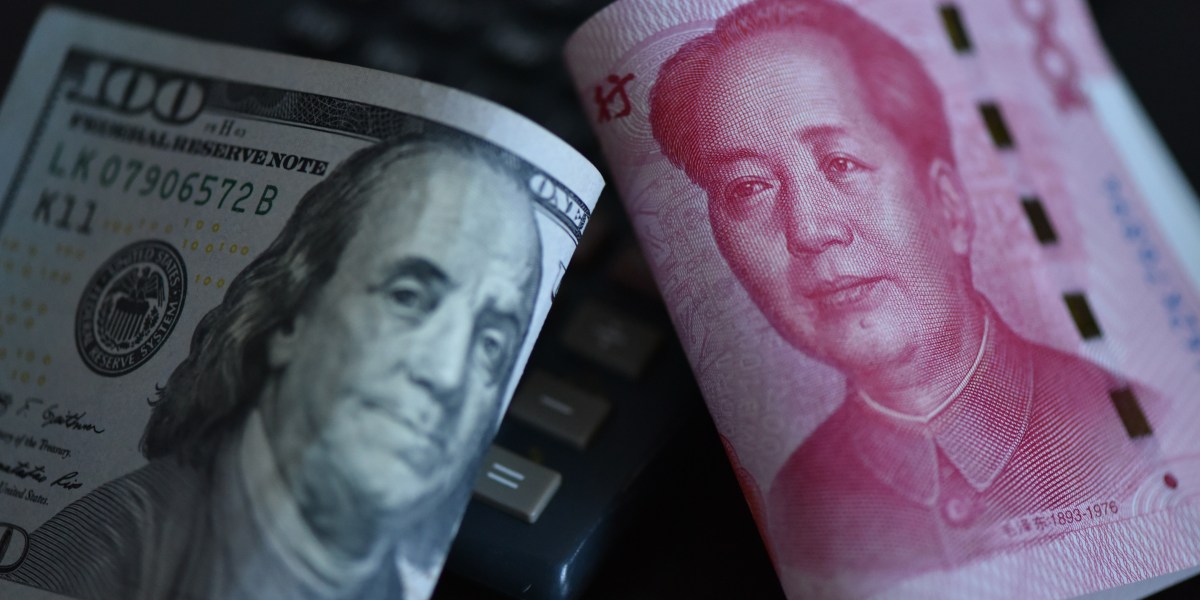
Despite efforts by Beijing, the yuan is not challenging the U.S. dollar in global reserves. Standard Chartered’s CEO, Jean Lu, stated that the yuan is not ready to take the top spot. She suggested that the yuan might compete with the yen or pound but not the dollar. The U.S. dollar still holds the majority of global reserves, at 57% in Q1 2026. The yuan’s share is only 2%, showing slow growth.
Capital Controls and Liquidity
Lu pointed to limited liquidity in offshore markets as a barrier for the yuan. She said that less than 2 trillion yuan is available globally, with most in Hong Kong. Capital controls in China restrict the flow of yuan into global markets. This makes it difficult for the yuan to gain traction outside of China. The People’s Bank of China is working to increase the yuan’s international use through offshore mechanisms.
Global Trade and Geopolitical Factors
Geopolitical tensions are pushing some countries to use the yuan as an alternative to the U.S. dollar. U.S. sanctions on Russia and Iran have increased the yuan’s use in trade. Southeast Asia is also seeing increased use of the yuan, with trade volumes between China and the region rising sharply. The Pinglu Canal is helping to boost trade by reducing logistics costs.
ASEAN and Chinese Investment
Chinese companies are investing in Southeast Asia, building supply chain ecosystems. Standard Chartered’s Patrick Lee said that China is not just exporting goods but also manufacturing in the region. He noted that ASEAN countries are seen as attractive for long-term investment. This shift is part of broader supply chain changes and geopolitical realignments.
Challenges and Opportunities
While Chinese investment is growing, some Southeast Asian manufacturers are struggling with overcapacity from Chinese goods. Thailand and Indonesia have seen factory closures due to cheap Chinese imports. However, Lu and Lee believe that China is committed to long-term manufacturing in the region. They see it as an opportunity for ASEAN to build up its industries and train workers.