Source: Fox News
Summary
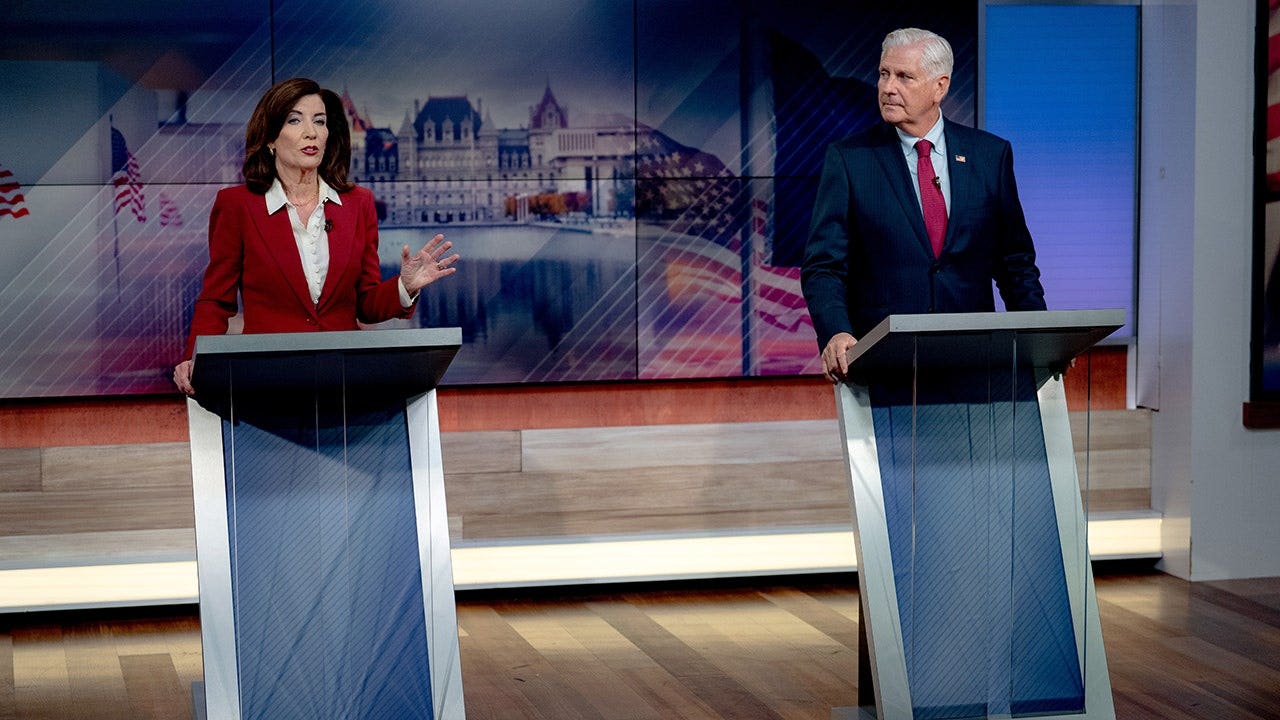
The New York gubernatorial race intensified as Democratic Gov. Kathy Hochul and Republican Bruce Blakeman debated, focusing on immigration, President Donald Trump, and inflation. Blakeman accused Hochul of enabling criminals by making New York a sanctuary state, citing a recent ICE-related shooting. Hochul criticized Blakeman for not condemning ICE’s actions and accused him of focusing on Trump instead of his record. The candidates also exchanged remarks on the economy and political endorsements.
Our Reading
As expected, the matter has reached another stage.
Blakeman blames Hochul for a shooting involving ICE.
Hochul says Blakeman refuses to condemn ICE.
Blakeman claims Hochul’s policies invite criminals.
Hochul says New York is not a sanctuary for criminals.
Blakeman praises Trump, Hochul mocks his endorsements.
Author: Evan Null
Debate Stage
The debate stage became a platform for accusations and counter-accusations. Blakeman focused on ICE’s actions and Hochul’s immigration policies, while Hochul defended her record and criticized Blakeman’s stance on Trump.
Blakeman claimed that Hochul’s sanctuary policies allowed criminals into New York, citing the recent shooting as evidence. He emphasized cooperation with ICE as a way to keep communities safe.
Hochul dismissed Blakeman’s claims as a non-answer, arguing that ICE’s conduct was reckless and dangerous. She pointed to the potential harm to children and the need for accountability.
The candidates also clashed over Trump, with Hochul blaming him for rising costs and Blakeman defending him and shifting the focus to Hochul’s record.
Blakeman’s endorsements from figures like Trump and Debra Messing were mentioned, while Hochul mocked his support base, highlighting the political divide in the race.
Immigration and Safety
The debate centered on immigration and public safety, with both candidates using the issue to attack each other. Blakeman framed his approach as a way to protect communities, while Hochul criticized his rhetoric as divisive.
Blakeman claimed that his cooperation with ICE led to the removal of over 2,000 illegal migrants with criminal records. He argued that Hochul’s policies prevented such efforts, making New York less safe.
Hochul countered that New York is not a sanctuary for criminals and that ICE’s actions were reckless. She emphasized the need for oversight and accountability, particularly in cases involving innocent bystanders.
The candidates’ exchange highlighted the broader debate over immigration policy and its impact on public safety, with each side presenting their approach as the solution.
Blakeman’s focus on ICE and Hochul’s defense of her record reflected the polarized nature of the race, with both candidates using the issue to appeal to their base.
Trump and the Economy
The debate also touched on Trump and the economy, with Hochul blaming him for rising costs and Blakeman defending his policies. The candidates used the issue to attack each other’s records.
Hochul accused Blakeman of focusing too much on Trump and not on his own performance. She argued that the state’s economic struggles were not his fault and that he lacked a real plan for improvement.
Blakeman, in turn, criticized Hochul’s record, pointing to high taxes and utility rates as evidence of her failures. He claimed that Trump’s policies had helped the country and that Hochul’s approach was failing New Yorkers.
The exchange revealed the broader political divide over the economy and the role of Trump in shaping it. Both candidates used the issue to frame themselves as the better choice for the state.
Blakeman’s endorsements from Trump and other figures were mentioned, while Hochul mocked his support, highlighting the personal and political nature of the race.
Endorsements and Rhetoric
Blakeman’s endorsements from figures like Trump and Debra Messing were a key part of his campaign strategy. He used these endorsements to build credibility and appeal to a broader audience.
Hochul, on the other hand, focused on her record and criticized Blakeman’s rhetoric, arguing that his approach was divisive and ineffective. She emphasized the need for a more inclusive and responsible approach to governance.
The candidates’ rhetoric reflected the broader political climate, with each using their platform to attack the other and promote their vision for the state.
Blakeman’s focus on Trump and Hochul’s defense of her policies highlighted the polarized nature of the race, with each candidate using the issue to appeal to their base.
The debate underscored the importance of endorsements and rhetoric in shaping public perception, with both candidates using these tools to gain an edge in the race.
Performance and Routines
The debate followed a familiar pattern, with each candidate using their time to attack the other and promote their own agenda. The exchange of accusations and counter-accusations became a routine part of the campaign.
Blakeman’s focus on ICE and Hochul’s defense of her record reflected the broader issues in the race, with each candidate using the debate to frame themselves as the better choice.
The candidates’ rhetoric and strategies were consistent with previous political performances, where the focus was on attacking the opponent and highlighting one’s own strengths.
The debate also revealed the performative nature of political discourse, where the goal was not to find common ground but to win over the audience.
Blakeman’s endorsements and Hochul’s critiques of his policies were part of the routine, showing how political moments often become performances rather than genuine discussions.