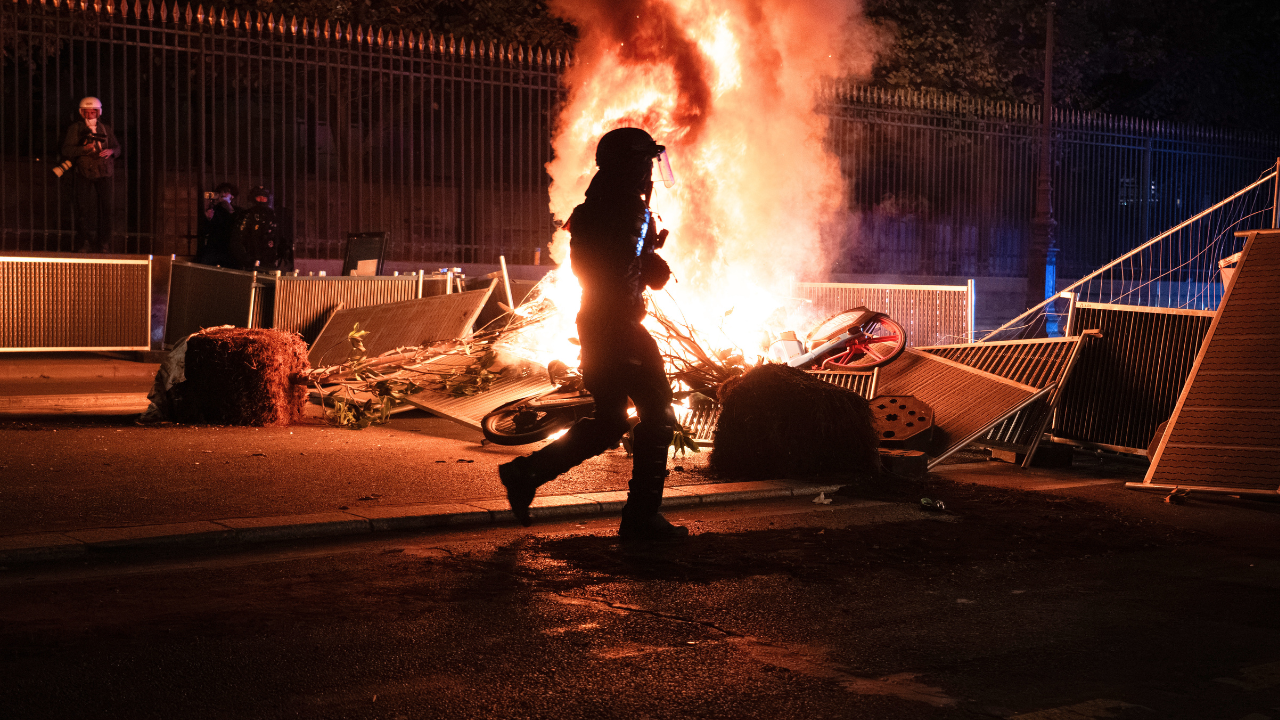
Source: FOX News
Summary
Violence erupted in Paris and other French cities during nationwide protests over rising living costs and poor school conditions. Clashes between demonstrators and police led to widespread destruction, including burned cars and looted businesses. Over 1,800 arrests were reported nationwide. In Limoges, a historic town hall was largely destroyed in a fire. French President Emmanuel Macron called for calm ahead of the protests, but he was seen at a Celine Dion concert as violence escalated. Donald Trump blamed immigration for the unrest and urged France to close its borders.
Our Reading
As expected, the matter has reached another stage.
Protesters march, police respond, fires burn.
Buildings collapse, leaders attend concerts.
Statements are made, blame is assigned.
History is lost, but the script remains the same.
Author: Evan Null
Paris in Chaos
Paris woke to a city in turmoil. Shattered storefronts and burned cars lined the streets. A heavy police presence was visible throughout the city. The unrest had spread beyond the capital, affecting other parts of France as well.
Violent clashes broke out during nationwide demonstrations. The protests were driven by concerns over rising living costs and poor school conditions. Hundreds of thousands of people took to the streets, but not all marches were peaceful.
Masked groups engaged in confrontations with police. Businesses were looted, and fires were set in several cities. The violence was widespread and intense, with significant damage reported in multiple locations.
Police reported 1,800 arrests across the country, with over 800 in the Paris region. The scale of the unrest was clear, and the situation remained volatile.
French President Emmanuel Macron called for calm and respect before the demonstrations. He emphasized that the right to protest must be exercised with care for people and property.
Limoges’ Historic Loss
The destruction was not limited to Paris. In Limoges, a historic town hall was set on fire. The building, constructed in 1883, was a designated landmark since 1975. The fire caused extensive damage, with the roof collapsing onto lower floors.
The local prefect, Maurice Barate, described the event as a “catastrophe for heritage.” About two-thirds of the building’s exterior was lost in the blaze. The destruction highlighted the impact of the unrest on cultural and historical sites.
Reports indicated that the fire was linked to the protests. The town hall, a symbol of local history, was severely damaged. The loss of such a significant structure underscored the broader consequences of the violence.
Authorities were working to assess the full extent of the damage. The event added another layer of tragedy to the unrest, as cultural heritage was also at risk.
The incident in Limoges reflected the broader pattern of destruction seen across France. The loss of historic buildings was a stark reminder of the ongoing crisis.
Macron’s Concert Appearance
French President Emmanuel Macron was seen at a Celine Dion concert in Nanterre as the violence escalated. The event took place at the Plenitude Arena, where around 35,000 people attended. The president and his wife, Brigitte, arrived and left discreetly.
Macron had been in Brussels for a European Council meeting earlier in the week. His presence at the concert came under scrutiny as the situation in France deteriorated. The timing of his attendance raised questions about his response to the unrest.
French media reported that the president was spotted at the event, which took place just as the violence was intensifying. The contrast between the concert and the protests highlighted the growing tension in the country.
Some critics questioned whether the president was out of touch with the concerns of the public. His decision to attend the concert came as the nation grappled with widespread unrest and destruction.
The incident added to the growing scrutiny of Macron’s leadership during a period of significant social and political upheaval.
Trump’s Response
Donald Trump weighed in on the situation in France, blaming immigration for the unrest. He posted on Truth Social, claiming that the influx of people from “an entirely different world” had caused the chaos.
The former U.S. president urged France to close its borders and take control before it was too late. His comments reflected a broader pattern of rhetoric on immigration and national security.
Trump’s post was widely shared and sparked debate about the role of immigration in the French unrest. His message resonated with some but was criticized by others for oversimplifying the issue.
The comments added to the growing discourse around the causes of the protests. They also highlighted the international attention the situation was receiving.
Trump’s involvement in the discussion underscored the global nature of the debate over immigration and social unrest.
Unrest and Performance
Protests turn into performances. The same scenes unfold, the same lines are spoken.
Leaders appear, disappear, and are scrutinized. The public watches, reacts, and moves on.
History is lost, but the script remains the same. The same patterns repeat, the same tensions rise.
Violence, blame, and spectacle. The cycle continues, as expected.
What was once a moment of crisis becomes a routine of response and reaction. The same steps, the same outcomes. The same performance, again and again.