Source: Fortune
Summary
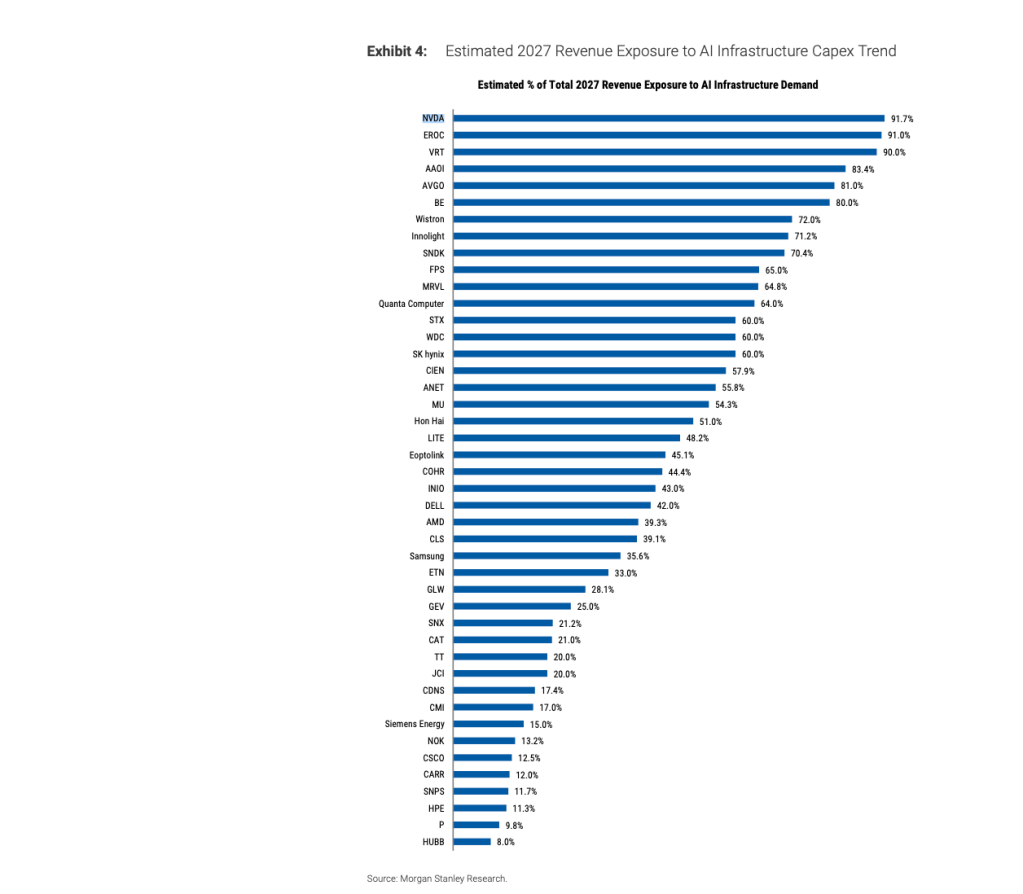
Morgan Stanley reported that 91.7% of Nvidia’s 2027 revenue depends on AI infrastructure demand, the highest exposure among major tech companies. The bank called Nvidia the best risk/reward in the sector, citing its expected $700 billion in revenue from hyperscalers and neocloud providers. The report estimates $1.58 trillion in AI-related spending in 2027, with $1 trillion contributing to S&P 500 revenue. SpaceX and Amazon Web Services together account for 54% of Nvidia’s hyperscaler revenue in 2027, according to the analysis.
Our Reading
The numbers tell one story.
Nvidia’s revenue is almost entirely tied to AI infrastructure.
SpaceX and Amazon drive most of that revenue.
Spending could break if money, power, or politics shift.
The company’s success is a bet on the AI boom.
Author: Evan Null
The $1.6 trillion
Morgan Stanley estimates that hyperscalers and AI cloud providers will spend $1.58 trillion in 2027, a 60% increase from this year’s $980 billion. The report includes $195 billion in data center leases, which are considered “synthetic capex.” Hyperscalers have committed to more than $1.1 trillion in leases that haven’t started yet.
About $1 trillion of the 2027 spending is expected to contribute to S&P 500 revenue, with nearly $700 billion going to Nvidia. Despite making up 5% of S&P 500 revenue, hyperscaler and neocloud customers drive about 25% of the index’s growth.
Nvidia’s customer base is even more concentrated. In 2027, SpaceX and Amazon Web Services account for 54% of the company’s hyperscaler revenue and 72% of its growth. Morgan Stanley’s model shows that Nvidia’s share of other hyperscalers’ spending will drop slightly from 18% in 2026 to 16% in 2027.
The bank argues that Nvidia is undervalued, trading at 15 times fiscal 2028 earnings. It expects the company to earn 25% to 50% on invested capital and says Wall Street has historically underestimated compute cycles by 38%.
Morgan Stanley also acknowledges that its estimates for SpaceX and Amazon may be conservative, which could create a low bar for other hyperscalers. The report notes that Nvidia expects to gain market share in the coming years.
What could break
The report outlines several risks to the $1.6 trillion AI spending forecast. Money is a key concern, as hyperscalers are expected to face a cash flow deficit in 2027, leading to more debt. Morgan Stanley models the cost of borrowing and finds that some companies, like Amazon and Alphabet, could see their interest coverage drop significantly.
Inflation is another risk. The report notes that a significant portion of recent spending increases is due to higher component prices, not increased volume. Amazon’s finance chief attributed a $20 billion increase in spending to rising memory costs, with no change in the build plan.
Power is also a concern. The report predicts a 32-gigawatt shortfall in U.S. data center power through 2028, which could lead to hoarding of GPUs and stranded inventory. However, it warns that buying equipment without power is unsustainable.
Politics could also disrupt the forecast. Morgan Stanley says data center restrictions are a potential wedge issue in the midterms, though it doesn’t expect a federal pause. Tax breaks are seen as a likely target regardless of election outcomes.
The supplier problem
Morgan Stanley’s downside case focuses on a timing problem. If AI spending plateaus, it argues that volumes could hold while prices fall, leading to margin compression for suppliers. The bank points to the 2022 memory downturn, where shipments fell only 5% but prices dropped 20% to 30%.
Nvidia is expected to be less affected in a downturn, as the report suggests the most disruption will occur at the “tail of the bullwhip” in smaller, less critical components. Nvidia, as the largest supplier, is at the other end of the supply chain.
The report also notes that Wall Street is underprepared for a deep downside, with the risk of both volume and price falling together being underappreciated. It calls this the “standard capital-cycle playbook,” but compressed by the concentration of hyperscaler customers.
Despite the risks, Morgan Stanley maintains that Nvidia is a strong bet, given its dominant position in the AI infrastructure market and the expected growth in spending.