Source: Fortune
Summary
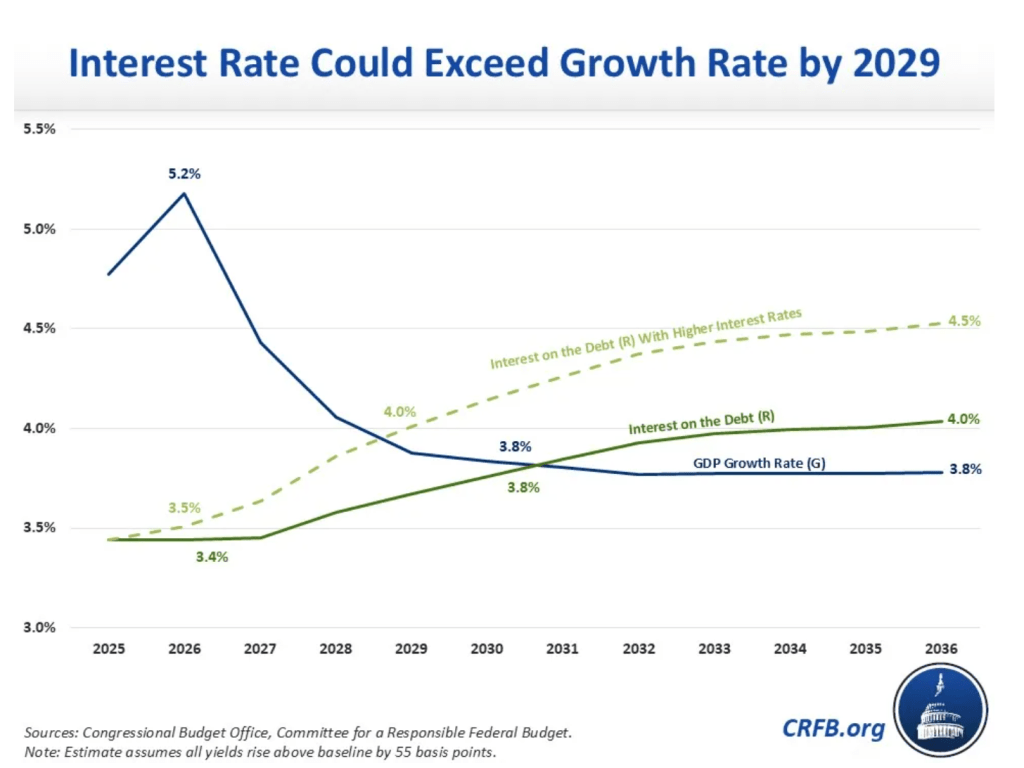
The federal government’s spending on debt interest has surpassed that of Medicaid, national defense, and all non-defense discretionary programs combined. The Committee for a Responsible Federal Budget warns that if Treasury yields remain elevated, interest costs could grow 2.5-fold, reaching $2.5 trillion by 2036. This could lead to a debt spiral, where rising interest costs boost debt, and rising debt boosts interest rates. The fiscal consequences extend beyond the government’s ledger, with higher Treasury yields pushing up interest rates across the economy. The CRFB prescribes deficit reduction as the most effective lever to bring interest rates down and prevent a fiscal crisis.
Our Reading
The numbers tell one story. The 30-year Treasury yield has surged past 5.19%, its highest level in almost 20 years. Kevin Warsh, Trump’s pick to chair the Federal Reserve, is an unknown quantity, and markets are pricing in the uncertainty. The fiscal consequences of high interest rates are dire, with interest costs projected to overtake Medicare spending by 2027. The CRFB warns that there is little time to lose in addressing the issue. The situation is a classic case of a debt spiral, where rising interest costs boost debt, and rising debt boosts interest rates.
Interest costs are projected to reach $2.5 trillion by 2036, pushing debt interest’s share of federal revenue to almost 30%. The government would be spending nearly as much on interest as on Social Security’s entire retirement program. The CRFB’s prescription is deficit reduction, which can ease near-term inflationary pressure and shrink the debt stock on which the government pays interest.
This is a textbook example of a debt spiral, where rising interest costs boost debt, and rising debt boosts interest rates. The situation is dire, and the CRFB’s warning should be heeded.