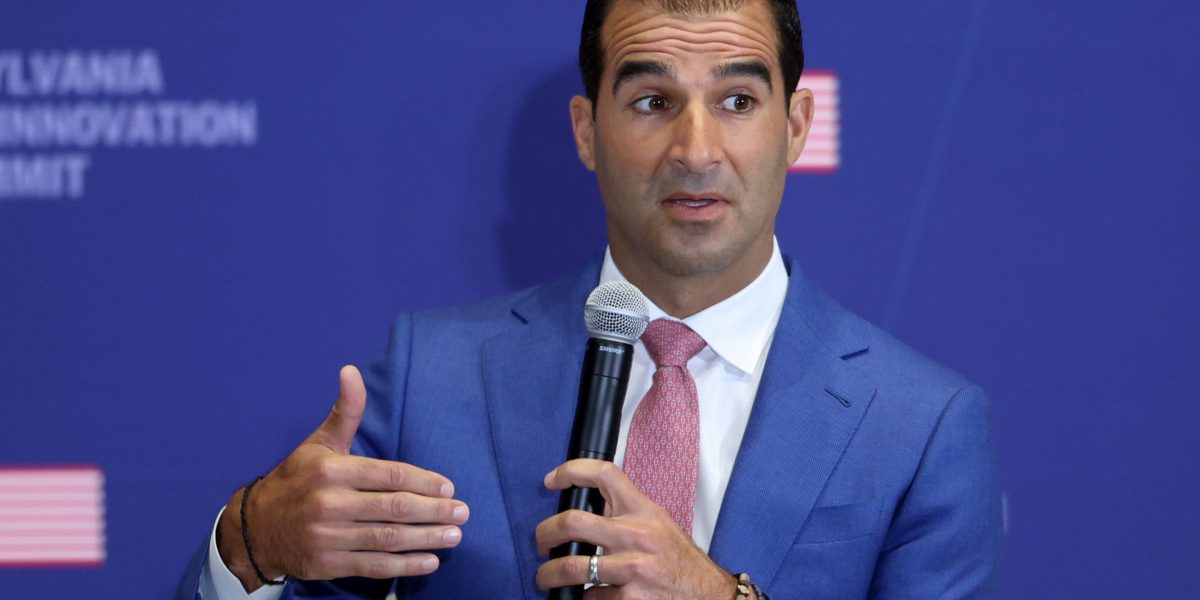
Source: Fortune
Summary
Dino Mavrookas, 46, transitioned from a Navy SEAL to a private-equity investor before becoming CEO of Saronic, a defense-tech startup valued at $9.25 billion. He left his role at Vista Equity Partners in 2022 to focus on founding Saronic, which develops autonomous maritime vehicles. The company has over 1,000 employees and plans to create 10,000 jobs through its Port Alpha shipyard in Texas. Mavrookas said his SEAL experience shaped his decision-making approach, emphasizing quick execution over perfect plans.
Our Reading
The numbers tell one story.
Mavrookas left a six-figure finance job to start a defense-tech company.
Saronic has 1,000 employees and 200 open roles.
Port Alpha will create 10,000 jobs and attract billions in investment.
His SEAL background shaped his leadership style, favoring execution over planning.
Author: Evan Null
How being a Navy SEAL prepared Mavrookas for entrepreneurship—and the C-suite
For Gen Z workers who feel intensive pressure to map out their entire careers—and pick a trajectory that’s simultaneously AI-proof, lucrative, and also interesting—Mavrookas’ path offers a different lesson: You don’t necessarily need to know exactly where you’re going before making a change.
In his case, each experience built on the one before it, eventually giving him a combination of technical, military, and business expertise that he could bring to the C-suite.
Before his time in finance, Mavrookas graduated in 2003 from Rutgers University with a degree in computer engineering. He then joined the Navy, spending 11 years as a Navy SEAL, including eight deployments and five years on SEAL Team Six.
That high-stakes experience dramatically shaped how he approaches decision-making as a CEO. Mavrookas has said one of the biggest lessons he took from his time as a SEAL was the importance of making decisions with the information available—and then executing quickly.
A good decision doesn’t always have a good outcome, and a bad decision doesn’t always have a bad outcome, Mavrookas said. You have to focus on the decision-making process.
JPMorgan CEO Jamie Dimon says Navy SEAL traits are good for business
Navy SEALs have long been up as a model for speed, execution, and accountability—critical traits that carry into the business world.
In fact, JPMorgan Chase CEO Jamie Dimon has specifically pointed to the SEALs as an example of how he wants small teams inside his 300,000-employee-strong finance giant to operate.
“The teams needed to tackle [specific problems] should be small and authorized with the decision-making ability to move and act like Navy SEALs or the Army’s Delta Force,” Dimon wrote in a letter to shareholders earlier this year.
Dimon and Mavrookas have another interest in common: shipbuilding. As the U.S. looks to revitalize its domestic construction, Dimon has become increasingly vocal about the need to train a new generation of skilled workers to build the ships.
“We need 300,000 electricians, welders, etc. to build ships in the next five or 10 years,” Dimon told CNBC in July, speaking from the Philadelphia Navy Yard.
Fortune’s take on Mavrookas’ career shift
Fortune reached out to Saronic for further comment.
Mavrookas’ career path shows how diverse experiences can lead to unexpected opportunities in the business world.
His transition from the military to finance to tech highlights the value of adaptability and resilience.
As Saronic expands, it continues to attract attention for its innovative approach to defense technology.
The company’s growth and vision reflect a broader trend in the defense industry toward technological advancement and workforce development.
Industry trends and future outlook
Saronic’s expansion into shipbuilding and autonomous maritime vehicles aligns with growing interest in defense technology.
The company’s plans for Port Alpha signal a major investment in the future of maritime infrastructure.
With a $9.25 billion valuation, Saronic is positioned as a key player in the defense-tech sector.
The company’s focus on innovation and workforce development could set a new standard for the industry.
As the defense sector evolves, Saronic’s success may influence future trends in technology and employment.