Source: Fortune
Summary
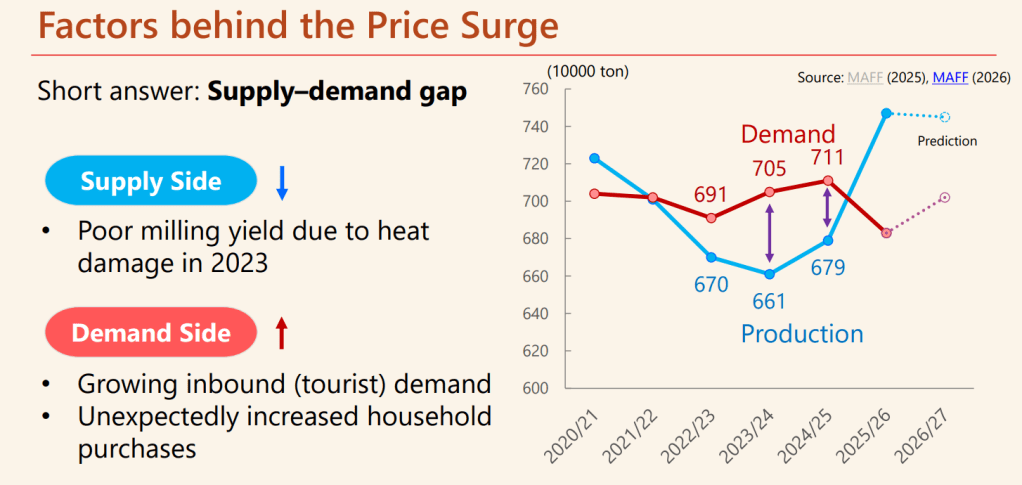
In 2023, extreme heat and drought damaged Japan’s rice crop, leading to a severe shortage that forced a government minister to resign. By 2026, the country faced a record surplus, prompting the government to buy back rice to stabilize prices. Experts, including Ryosuke Inoue, were surprised by the rapid shift. The shortage was driven by climate events and increased demand, while the surplus resulted from farmers boosting production in response to higher prices. The government’s delayed response and opaque distribution system also contributed to the crisis.
Our Reading
The numbers tell one story.
Japan went from a rice shortage to a surplus in two years.
Prices spiked, then collapsed, with the government scrambling to manage the cycle.
Farmers responded to high prices by increasing production, creating an oversupply.
The system lacks buffers, and climate shocks are becoming more frequent.
Author: Evan Null
Supply stock shock
Japan’s rice stock lacked a buffer, and the distribution system was opaque. Regulators struggled to understand how rice moved from farmers to consumers during the shortage. This lack of transparency delayed effective responses and exacerbated the crisis.
Importing from the U.S.
Japan imports most of its rice from the U.S., despite domestic production. A 2025 trade deal increased U.S. rice imports, forcing Japan to rely more on foreign sources during its shortage. This shift highlighted the country’s vulnerability and the political challenges of balancing domestic farming with global trade.
Aging farmers and shrinking land
Japanese rice farmers are aging, with the average age at 67.7. The land they leave behind is hard to reclaim, especially in mountainous areas. This demographic challenge limits the country’s ability to adapt to changing conditions and maintain stable production.
Proposed solutions
Ryosuke Inoue proposed a U.S.-style safety net for farmers, paying them when prices fall below production costs. Japan tried a similar policy in 2011 but abandoned it. Inoue argues that a flexible system with a safety net would better handle price fluctuations than the current boom-and-bust cycle.
Climate change and future risks
Climate change is increasing the frequency and severity of weather shocks. Droughts and heatwaves are already affecting rice yields. Farmers are adopting heat-tolerant varieties, but adoption remains low. Experts warn that without structural changes, Japan’s rice system will continue to face instability.