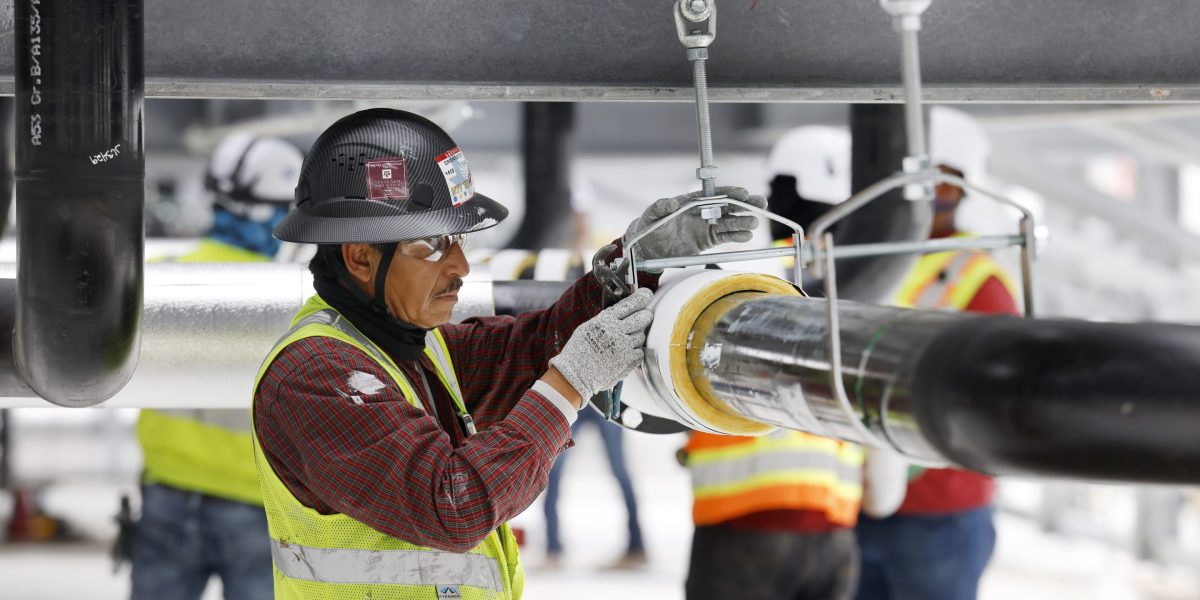
Source: Fortune
Summary
Data centers are creating thousands of skilled trade jobs in the U.S., but a shortage of workers remains a challenge. Google’s Tim Chadwick noted hundreds of thousands of open roles, including electricians and pipefitters. A JLL report estimates 2.1 million skilled trades jobs could go unfilled by 2030. Nvidia CEO Jensen Huang and GM’s Mary Barra have highlighted the growing demand for skilled workers. McKinsey projects $6.7 trillion in data center investment by 2030. A 2026 survey found 58% of construction firms face increased competition for skilled labor.
Our Reading
The numbers tell one story.
Skilled trades are booming, but not enough workers are showing up.
CEOs are pushing for more attention to blue-collar careers.
Companies are forming alliances to fix the skills gap.
There’s a mismatch between job availability and worker readiness.
Author: Evan Null
Skilled Trades Are in High Demand
The rise of data centers has created a surge in demand for skilled trades workers, including electricians, plumbers, and pipefitters. These roles are seen as stable and well-paying, with some positions offering six-figure salaries. However, the U.S. is facing a significant shortage of workers in these fields, with millions of jobs expected to go unfilled by 2030.
Despite the growing opportunities, many young people are still being steered toward four-year college degrees, leaving skilled trades underappreciated and underfunded. This has led to a labor shortage that is affecting industries across the country, from construction to technology.
Companies like Google and Nvidia are highlighting the need for more workers in the skilled trades, while executives like Mary Barra and Jensen Huang are calling for a shift in how these careers are perceived. They argue that skilled trades offer long-term financial stability and are less vulnerable to automation than other jobs.
The challenge remains in attracting and training enough workers to meet the growing demand. With data centers requiring massive investment and construction, the need for skilled labor is only going to increase, making it a critical issue for the economy and workforce development.
As more companies join forces to address the skills gap, the focus is on creating pathways for students and workers to enter the trades, ensuring that the U.S. can meet the demands of the AI-driven infrastructure boom.
Corporate Efforts to Address the Skills Gap
Major corporations are stepping in to help bridge the gap between education and the labor market. Ford, Google, BlackRock, and Carhartt have formed the Alliance for America’s Skilled Trades, aiming to build better pathways for vocational training. The group is working to change public perception and encourage more young people to consider careers in the trades.
Similarly, the Lowe’s Foundation launched the Building Futures Skilled Trades Coalition, bringing together companies like NVIDIA, AT&T, Bank of America, and General Motors. These partnerships are focused on creating more accessible training programs and improving collaboration between education and industry.
The goal is to ensure that more people can transition into skilled trades, which offer stable, well-paying jobs. These efforts reflect a growing recognition that the U.S. needs to invest in its workforce to keep up with the demands of the digital economy.
Despite these initiatives, the challenge remains significant. The education system has long emphasized college degrees, leaving vocational training underfunded and undervalued. This has led to a shortage of workers in many skilled trades, making it harder for companies to fill open positions.
As the demand for skilled labor continues to grow, these corporate efforts may play a key role in reshaping how the U.S. approaches workforce development and career training.
Challenges in the Skilled Trades
While the demand for skilled trades is high, the jobs themselves come with challenges that make them less attractive to some workers. These roles often require physical labor, long hours, and working in extreme weather conditions. Construction projects are also project-based, meaning workers may need to relocate frequently, which can be a deterrent for some.
Data center construction, in particular, creates a large number of temporary jobs, but once the facility is operational, the number of workers needed drops significantly. This creates a mismatch between the availability of jobs and the stability that some workers seek.
A 2026 survey of construction firms found that 58% reported increased competition for skilled workers, while 49% faced rising wage pressures. Another 37% cited the availability of workers or subcontractors as a major challenge. These findings highlight the difficulty of attracting and retaining skilled labor in the industry.
Despite the challenges, the long-term outlook for skilled trades remains positive. With the continued growth of data centers and other infrastructure projects, the demand for these workers is expected to increase. However, without a significant shift in how these careers are perceived and supported, the shortage may persist.
The success of these efforts will depend on how effectively companies and education institutions can collaborate to create more accessible training programs and change public perceptions about the value of skilled trades.
The Role of Education and Training
Education and training programs are critical to addressing the skilled trades shortage. However, these programs have historically received less investment compared to traditional four-year college degrees. This has led to a lack of awareness and access for many students who might otherwise consider these careers.
Apprenticeships, technical training, and on-the-job experience are essential for developing the skills needed in the trades. However, without strong support from schools and employers, many young people are not exposed to these opportunities early enough.
Some companies are stepping in to fill this gap. For example, the Building Futures Skilled Trades Coalition is working to create more accessible training programs and improve collaboration between education and industry. These efforts aim to ensure that more students can transition into skilled trades and find stable, well-paying jobs.
Despite these initiatives, the challenge remains in changing the perception that college degrees are the only path to success. Many students are still being encouraged to pursue traditional academic routes, even when skilled trades may offer better long-term outcomes.
As the demand for skilled labor continues to grow, the role of education and training will be crucial in preparing the next generation of workers for these careers.
Future Outlook for the Skilled Trades
The future of the skilled trades looks promising, but the path to meeting the growing demand remains uncertain. With the continued expansion of data centers and other infrastructure projects, the need for skilled workers is expected to increase significantly. However, without a substantial shift in how these careers are perceived and supported, the shortage may persist.
Companies like Google and Nvidia are highlighting the potential for growth in the skilled trades, while executives like Mary Barra and Jensen Huang are calling for a change in how these careers are viewed. Their messages suggest that the trades offer stable, well-paying jobs that are less vulnerable to automation than many other fields.
Despite these positive signs, the challenge of attracting and training enough workers remains. The education system has long emphasized college degrees, leaving vocational training underfunded and undervalued. This has led to a shortage of skilled workers, making it harder for companies to fill open positions.
As more companies join forces to address the skills gap, the focus is on creating better pathways for students and workers to enter the trades. These efforts may help to reshape how the U.S. approaches workforce development and career training.
Ultimately, the success of these initiatives will depend on how effectively they can change public perceptions and create more accessible training programs. If done well, the skilled trades could become a more attractive and viable option for a growing number of workers.