Source: Fox News
Summary
Anti-Israel activists in Washington, D.C., London, Paris, Madrid and Kuala Lumpur marched with chants of “Free, free Palestine” and “From the river to the sea.” Three anti-Israel leaders confirmed the goal of a single state encompassing Israel, the West Bank and Gaza, with a Palestinian right of return and equal rights for Jews. They described Israel as a Jewish nation-state that would cease to exist. The movement rejects the two-state solution, with activists emphasizing a one-state vision. The U.S. Palestinian Community Network and other groups support this plan, while Israeli leaders reject the accusations of apartheid and genocide.
Our Reading
As expected, the matter has reached another stage.
Leaders say the goal is one state called Palestine.
They mention right of return and equal rights for Jews.
Protesters chant “Free Palestine” and reject the two-state solution.
One state, one name, one vision—repeated like a ritual.
Author: Evan Null
Anti-Israel Activists March in Global Protests
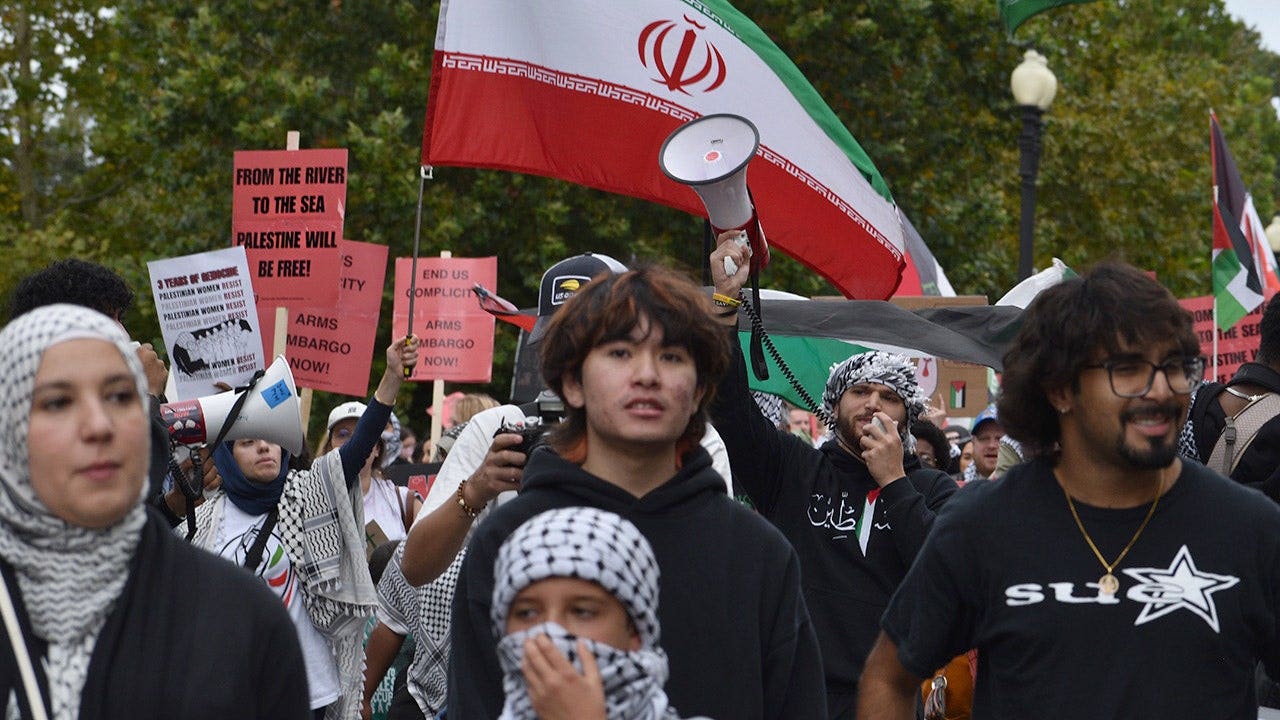
On the weekend, anti-Israel activists gathered in cities across the world, including Washington, D.C., London, Paris, Madrid, and Kuala Lumpur. They marched through the streets, chanting slogans like “Free, free Palestine” and “From the river to the sea, Palestine will be free.” These protests were part of a coordinated global action, with participants expressing their demands for a single state encompassing Israel, the West Bank, and Gaza.
Three anti-Israel leaders, interviewed by Fox News Digital, confirmed the goal of creating a single state called “Palestine.” This state would include the modern-day Israel, the West Bank, and Gaza, with a Palestinian “right of return” and equal political, voting, and citizenship rights for Palestinians and Jews. They described Israel as a Jewish nation-state that would no longer exist in its current form.
The movement rejects the two-state solution, which has been the focus of international diplomacy for decades. Instead, activists emphasize a one-state vision, where Palestinians and Jews would live together in a single, democratic, secular state. This vision includes the right of return for Palestinian refugees and their descendants, as well as equal rights for all citizens.
Leaders from the U.S. Palestinian Community Network and other groups support this plan. They argue that the only way to achieve peace and justice in the region is through a single state. However, Israeli leaders have rejected these accusations, maintaining that Israel is the nation-state of the Jewish people with equal civil and political rights for all citizens.
The protests also included chants and slogans that explicitly rejected the two-state solution. In New York City, the Party for Socialism and Liberation circulated a video of protesters chanting, “1-2-3-4. Occupation no more. 5-6-7-8. Israel is a terrorist state.” In London, the Palestine Solidarity Campaign promoted a video of a woman shouting, “There is only one state!” and protesters responding with “Palestine, ’48!”
Leaders Describe One-State Vision
Hatem Abudayyeh, founder of the U.S. Palestinian Community Network, described the goal of a single democratic state called “Palestine.” He emphasized that this state would include the West Bank, Gaza, and the “1948 Palestinian territories,” which refers to the land Israel claimed as its nation in 1948. Abudayyeh argued that the only way to achieve peace and justice is by dismantling the “racist system of Zionism.”
Miko Peled, an Israeli-born Jewish activist, also supported the one-state vision. He described “Free Palestine” as a post-Zionist, post-apartheid state with equal rights for all. Peled stated that the country should be called “Palestine” because that was its name for thousands of years. He argued that Israel is currently a single state, but one that is an “apartheid state.”
Sam Husseini, a Palestinian-American congressional candidate, proposed an alternative name for the one-state vision: “1948.” He suggested that the country could be named after the year Israel declared independence, which Palestinians refer to as the “Nakba,” or catastrophe. Husseini argued that if the new state is called Palestine, many Jews would eventually accept the name, as long as they have equal rights and protection.
These leaders emphasized that the one-state vision is not a new idea. They stated that it has been the goal of the movement for decades. Abudayyeh said that the U.S. Palestinian Community Network has always advocated for a single democratic state, and that the right of return for Palestinian refugees has been a key point of unity since the organization’s founding.
Abudayyeh compared the Palestinian movement’s objective to the international campaign against apartheid South Africa. He argued that the movement is gaining international consensus, with many people now recognizing that Israel does not have the right to exist as a “racist, Zionist, apartheid, white supremacist state.”
Protesters Reject Two-State Solution
During the protests, participants explicitly rejected the two-state solution, which has been the focus of international diplomacy for decades. In New York City, the Party for Socialism and Liberation circulated a video of protesters chanting, “1-2-3-4. Occupation no more. 5-6-7-8. Israel is a terrorist state.” The video showed protesters marching through the streets, emphasizing their opposition to the current status quo.
In London, the Palestine Solidarity Campaign promoted a 15-second video of a woman with a megaphone shouting, “There is only one state!” and protesters responding with “Palestine, ’48!” The message was clear: the movement is committed to a single state, not two separate ones. The video was widely shared on social media, highlighting the growing support for the one-state vision.
In Washington, D.C., protesters carried signs declaring, “LAND YOU HAVE 2 KILL FOR IS NOT YOURS,” which challenged Israel’s claim to the land itself. A banner proclaiming, “THE FIGHT FOR LIBERATION IS OURS,” framed the struggle as one for the territory. These messages reflected the movement’s focus on the land and its control, rather than on political negotiations or compromises.
Many of the protesters did not address the Hamas attacks on Israel on Oct. 7, 2023, but some have called them justified. The movement’s focus remains on the one-state vision, with activists emphasizing the need for a single, democratic, secular state that includes all people who live in the region.
The one-state demand is being amplified within a powerful protest infrastructure. The broader “red-green” alliance brings socialist and communist groups together with Palestinian and Muslim activist organizations. This network includes groups like the Democratic Socialists of America and nonprofits funded by Neville Roy Singham, an American-born tech tycoon living in Shanghai. These groups help organize, promote, and amplify anti-Israel demonstrations.
Activists Describe One-State Vision
Hatem Abudayyeh, founder of the U.S. Palestinian Community Network, described the goal of a single democratic state called “Palestine.” He emphasized that this state would include the West Bank, Gaza, and the “1948 Palestinian territories,” which refers to the land Israel claimed as its nation in 1948. Abudayyeh argued that the only way to achieve peace and justice is by dismantling the “racist system of Zionism.”
Miko Peled, an Israeli-born Jewish activist, also supported the one-state vision. He described “Free Palestine” as a post-Zionist, post-apartheid state with equal rights for all. Peled stated that the country should be called “Palestine” because that was its name for thousands of years. He argued that Israel is currently a single state, but one that is an “apartheid state.”
Sam Husseini, a Palestinian-American congressional candidate, proposed an alternative name for the one-state vision: “1948.” He suggested that the country could be named after the year Israel declared independence, which Palestinians refer to as the “Nakba,” or catastrophe. Husseini argued that if the new state is called Palestine, many Jews would eventually accept the name, as long as they have equal rights and protection.
These leaders emphasized that the one-state vision is not a new idea. They stated that it has been the goal of the movement for decades. Abudayyeh said that the U.S. Palestinian Community Network has always advocated for a single democratic state, and that the right of return for Palestinian refugees has been a key point of unity since the organization’s founding.
Abudayyeh compared the Palestinian movement’s objective to the international campaign against apartheid South Africa. He argued that the movement is gaining international consensus, with many people now recognizing that Israel does not have the right to exist as a “racist, Zionist, apartheid, white supremacist state.”
Protesters and Leaders Emphasize One-State Vision
During the protests, participants emphasized the one-state vision, with leaders and activists describing the goal of a single state encompassing Israel, the West Bank, and Gaza. This state would include a Palestinian “right of return” and equal political, voting, and citizenship rights for Palestinians and Jews. Activists argue that this is the only way to achieve peace and justice in the region.
Leaders from the U.S. Palestinian Community Network and other groups support this plan. They argue that the only way to achieve peace and justice is through a single state. However, Israeli leaders have rejected these accusations, maintaining that Israel is the nation-state of the Jewish people with equal civil and political rights for all citizens.
The movement rejects the two-state solution, which has been the focus of international diplomacy for decades. Instead, activists emphasize a one-state vision, where Palestinians and Jews would live together in a single, democratic, secular state. This vision includes the right of return for Palestinian refugees and their descendants, as well as equal rights for all citizens.
Protesters explicitly rejected the two-state solution during the demonstrations. In New York City, the Party for Socialism and Liberation circulated a video of protesters chanting, “1-2-3-4. Occupation no more. 5-6-7-8. Israel is a terrorist state.” In London, the Palestine Solidarity Campaign promoted a video of a woman shouting, “There is only one state!” and protesters responding with “Palestine, ’48!”
These messages reflected the movement’s focus on the land and its control, rather than on political negotiations or compromises. Many of the protesters did not address the Hamas attacks on Israel on Oct. 7, 2023, but some have called them justified. The movement’s focus remains on the one-state vision, with activists emphasizing the need for a single, democratic, secular state that includes all people who live in the region.