
Source: Fortune
Summary
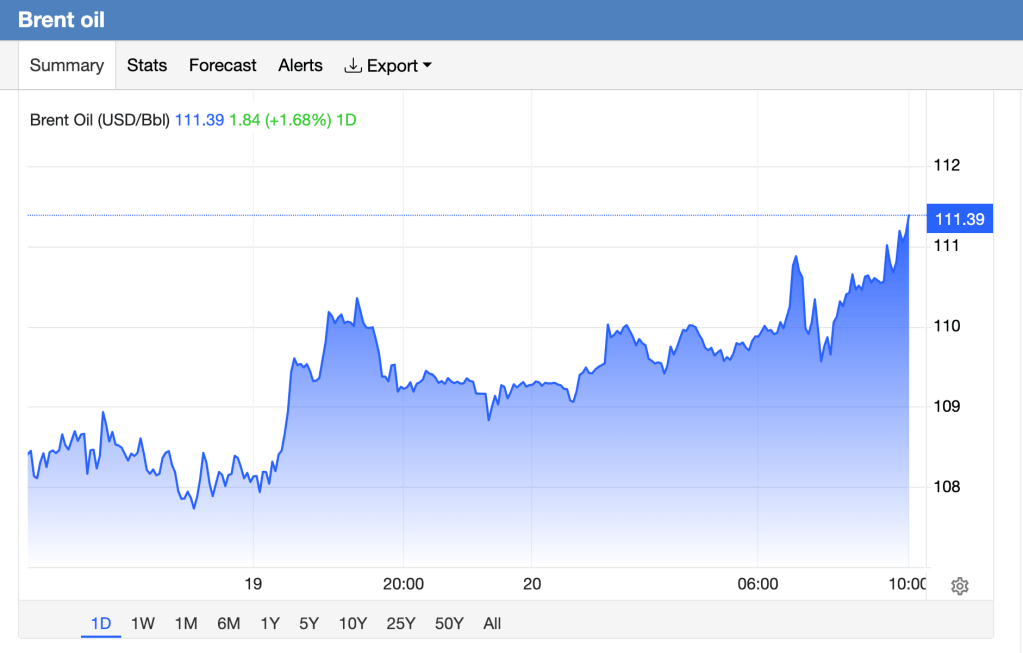
Global markets declined as S&P 500 futures fell ahead of the New York open. Asian and European markets were hit by a sharp drop in South Korea’s AI IPO, Elice, which lost 30% on its debut. Oil prices rose to $111 per barrel after Saudi Arabia canceled its Future Investment Initiative meeting. France imposed a curfew following riots, and European bond yields rose. In the U.S., Q3 earnings season started weakly, with 80% of S&P 500 companies beating expectations, but earnings per share fell short of forecasts.
Our Reading
The numbers tell one story.
Global markets sold off as oil hit $111, South Korea’s AI IPO collapsed, and France faced unrest. S&P 500 futures were flat, but earnings season started weakly. Tech stocks showed a split between spenders and sellers. AI capex is boosting profits now but will become a cost by 2028. Investors are watching for signs of a slowdown in tech spending.
Corporate language masks uncertainty with terms like “efficiency” and “headwinds.”
Author: Evan Null
Global Markets React to Multiple Crises
Global markets faced pressure as S&P 500 futures declined before the New York open. The sell-off followed a tough day in Asia and Europe, where South Korea’s AI IPO, Elice, dropped 30% on its debut. Oil prices rose to $111 per barrel, and French bond yields hit a 20-year high. The situation worsened as France imposed a curfew after days of riots in Paris. Similar unrest spread to Milan, raising concerns about a broader European crisis.
The cancellation of Saudi Arabia’s Future Investment Initiative meeting, known as “Davos in the Desert,” added to the uncertainty. The event, which was set to bring together top executives like Alphabet’s Ruth Porat and Goldman Sachs’ David Solomon, was canceled after Houthi attacks on Riyadh’s airport. The Houthis also attacked two tankers in the Strait of Hormuz, further spooking markets.
Asian markets were hit hard, with South Korea’s KOSPI down 3.73%, Japan’s Nikkei 225 down 1.30%, and China’s CSI 300 down 0.54%. The U.S. market remained cautious as S&P 500 futures were flat, despite a 0.41% gain the previous day. The global economic outlook remains fragile, with multiple factors contributing to market volatility.
Investors are increasingly wary of the AI sector, as seen in the sharp decline of Elice’s stock. While AI spending is expected to boost earnings in the short term, analysts warn that the costs will come due in the future. The tech sector is showing signs of a split, with companies that benefit from AI spending outperforming those that invest in it.
As the Q3 earnings season gets underway, the weak start has raised concerns about the broader economic outlook. With 46 S&P 500 companies reporting so far, 80% beat expectations, but earnings per share fell short of forecasts. Analysts are closely watching for signs of a slowdown in tech spending, which could impact the market in the coming months.
AI Spending and Earnings Volatility
The AI boom is driving earnings growth, but analysts warn that the costs will come due in the future. According to Glenmede, AI capital expenditures are boosting profits for the S&P 500 by 9% in 2026, but the depreciation costs will start to show up in 2028. This could create a headwind for companies that have invested heavily in AI infrastructure.
The split between AI spenders and sellers is becoming more apparent. While companies like Microsoft, Meta, and Broadcom have seen their stocks decline, those benefiting from AI spending, such as SK hynix and Samsung, have seen significant gains. This divergence highlights the uneven impact of the AI boom on different sectors of the market.
Analysts at Deutsche Bank note that the AI trade has created a market where companies that pay for AI are underperforming, while those that receive the investment are outperforming. This trend has been evident since October 2025, with the AI basket of stocks up around 18%, but the underlying performance is mixed.
The shift in AI spending is also affecting the broader tech sector. Major hyperscalers are expected to go cash flow negative this year due to increased debt financing. This could lead to a slowdown in AI capex spending next year, as companies adjust to the new financial reality.
As the AI sector continues to evolve, investors are watching for signs of a potential slowdown. The current earnings season is a key indicator of how the market is reacting to the challenges and opportunities presented by AI. The coming months will be critical in determining the long-term impact of the AI boom on the global economy.
Q3 Earnings Season Starts Slowly
The Q3 earnings season started with mixed results, as 46 S&P 500 companies reported so far. According to Bank of America, 80% of these companies beat earnings expectations, which is lower than the 88% beat rate in Q2. This suggests that the market is beginning to adjust to the new economic reality.
Despite the mixed results, earnings per share for the S&P 500 fell 0.3% below analysts’ expectations, according to Wells Fargo. This marks one of the weakest starts to an earnings season in history, raising concerns about the overall health of the market.
The weak start to the earnings season has led to increased uncertainty among investors. With global markets facing multiple challenges, including rising oil prices and political instability, the outlook for the coming months remains unclear.
Analysts are closely watching for signs of a potential slowdown in earnings growth. The current data suggests that the market is still adjusting to the new economic conditions, and the coming months will be critical in determining the long-term impact of these challenges.
As the earnings season continues, investors are looking for more clarity on the performance of key sectors. The tech sector, in particular, is under scrutiny as companies navigate the challenges of AI spending and the potential for a slowdown in investment.
Global Economic Uncertainty and Market Volatility
The global economic landscape is becoming increasingly uncertain, with multiple factors contributing to market volatility. The recent sell-off in global markets has been driven by a combination of geopolitical tensions, rising oil prices, and concerns about the AI sector. These factors are creating a challenging environment for investors and businesses alike.
The cancellation of the Future Investment Initiative meeting in Saudi Arabia has added to the uncertainty, as it was expected to bring together some of the world’s top business leaders. The event was canceled following Houthi attacks on Riyadh’s airport, which has raised concerns about the stability of the region.
At the same time, the situation in France is worsening, with the government imposing a curfew after days of riots and looting in Paris. The unrest has spread to other parts of Europe, including Milan, raising fears of a broader economic crisis. These events are contributing to a sense of unease among investors, who are increasingly cautious about the global economic outlook.
The impact of these events is being felt across multiple markets, with Asian, European, and U.S. indices all showing signs of weakness. The S&P 500 futures are flat, while European markets are down, and Asian markets are struggling with significant declines. This widespread volatility is a clear sign that the global economy is under pressure.
As the situation continues to evolve, investors are closely watching for signs of a potential recovery. The coming weeks will be critical in determining whether the global economy can stabilize or if further challenges are on the horizon.
Investor Sentiment and Market Outlook
Investor sentiment is increasingly cautious as the global market faces multiple challenges. The recent sell-off in S&P 500 futures and the sharp decline in Asian markets highlight the growing uncertainty. Investors are looking for signs of stability, but the current environment is proving to be highly volatile.
The AI sector is a key area of concern, with investors questioning the long-term sustainability of the boom. While the sector has driven earnings growth, the potential for a slowdown in AI spending is raising concerns about the future of tech stocks. This uncertainty is contributing to the overall market volatility.
The situation in France and the Middle East is also affecting investor sentiment. The imposition of a curfew in Paris and the Houthi attacks on the Strait of Hormuz are adding to the sense of instability. These events are creating a challenging environment for businesses and investors, who are trying to navigate the uncertainties of the current market.
Analysts are closely watching the Q3 earnings season for clues about the health of the market. The weak start to the season has raised concerns about the overall economic outlook, with investors looking for more clarity on the performance of key sectors. The tech sector, in particular, is under scrutiny as companies adjust to the challenges of AI spending and the potential for a slowdown in investment.
As the market continues to evolve, investors are bracing for further volatility. The coming months will be critical in determining the long-term impact of the current challenges on the global economy. For now, the focus remains on navigating the uncertainties and preparing for potential changes in the market landscape.