Source: Fortune
Summary
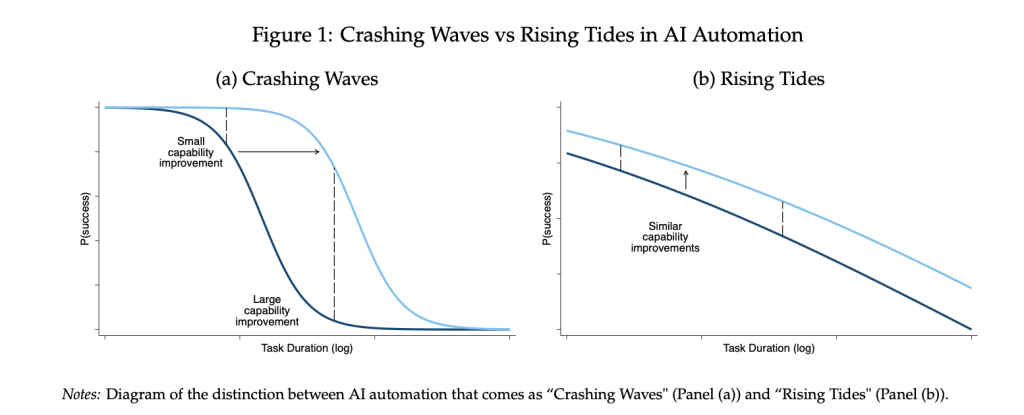
A recent study by MIT FutureTech found that AI’s impact on the labor market is more like a “rising tide” than a sudden catastrophe. The study tested 17,000 evaluations of LLM outputs from domain-expert workers across 3,000 labor market tasks and found that AI successfully completed 50-75% of text-based tasks at a minimally acceptable quality level. The improvement trajectory is steep, with failure rates halving every 2-3 years. The study suggests that AI could complete most text-based tasks with 80-95% success rates by 2029. However, the adoption of AI is still slow, with only 19% of US establishments having adopted AI, and many companies lack the right data infrastructure to fully leverage AI.
Our Reading
The numbers tell one story. FOBO, or the Fear of Becoming Obsolete, is a real concern for many workers, with 40% of workers naming AI-driven job loss as one of their primary fears. The MIT study’s findings suggest that AI is improving rapidly, but the transformation is likely to arrive as a steady, visible tide rather than a sudden drowning. The window to adapt is real, but it requires companies to adopt AI and provide adequate training and reskilling opportunities for workers.
The study’s findings also highlight the gap between the technology’s capabilities and the organizational plumbing needed to actually use it. Many companies lack the right data infrastructure to fully leverage AI, and the adoption of AI is still slow.
The pressure to adopt AI is relentless, with 83% of executives saying they lack the right data infrastructure to fully leverage AI. The study’s findings suggest that companies need to treat AI as a tool, not a verdict, and provide adequate training and reskilling opportunities for workers to adapt to the changing landscape.
The MIT study’s findings have significant implications for how companies plan and how workers prepare for the impact of AI on the labor market.
The study’s findings also highlight the need for companies to adopt a strategic approach to AI adoption, rather than simply reacting to the technology’s capabilities.
FOBO is rational, but the antidote is not denial or paralysis – it’s exactly what the workers thriving inside EY are already doing: treating AI as a tool, not a verdict.