—
Source: Fox News
Summary
Artificial intelligence is making political advertising more affordable and faster to produce, allowing campaigns to create attack ads, memes, and targeted messages at a lower cost. Campaign operatives can now generate content in minutes using generative AI, replacing the need for large teams. Ad-tracking firms have identified dozens of AI-influenced ads in federal and state races. While some campaign consultants see AI as a valuable tool, others warn that it cannot replace the need for authentic messaging. The effectiveness of AI-generated content in winning elections remains uncertain.
Our Reading
As expected, the matter has reached another stage.
Campaigns use AI to make ads faster and cheaper.
Some ads use AI voices and images to mimic real people.
Ads go viral but don’t always lead to victory.
People still want messages that feel real.
Author: Evan Null
AI in Political Advertising
Artificial intelligence is dramatically lowering the cost of political advertising, allowing campaigns to churn out attack ads, memes and other targeted messages at a pace that would have been prohibitively expensive just a few years ago.
In the political ad wars, campaign operatives can now use generative AI to produce in minutes or hours what once required days by a team of writers, voice talent, video shoots and production teams.
The shift is turning political creative from an expensive campaign asset into something much more affordable and closer to disposable content, potentially giving candidates and outside groups the ability to flood voters with more messages.
While the exact number is difficult to identify, the ad-tracking firm AdImpact had identified 29 campaign ads in federal and gubernatorial contests that disclosed using AI content, as of two weeks ago.
Meanwhile, the Wesleyan Media Project, which also counted ads that did not make AI disclosures, has identified at least 164 AI-influenced ads this cycle.
Opinions on AI in Campaigns
Republican consultant Jesse Hunt told Fox News Digital that AI allows more content in varying styles and is cost effective.
Democratic strategist Chris Moyer said AI gives campaigns more tools for less cost, democratizing access to resources.
Will Ritter, a longtime Republican ad maker, said his agency now uses AI in most of its ads, noting the technology allows people to make almost anything.
But Ritter added that knowing how to use the tools is still essential to creating effective ads.
Campaign veterans say not using AI means being behind the eight ball, as it is becoming a standard tool in political messaging.
Examples of AI in Campaigns
Republican gubernatorial candidate Brian Shortsleeve of Massachusetts used an AI-generated radio ad featuring an AI version of Gov. Maura Healey’s voice.
The ad raised questions about the legal limits of AI in elections, as 31 states have laws regulating political deepfakes.
In Los Angeles, mayoral candidate Spencer Pratt used AI-generated videos that went viral, boosting his campaign’s online momentum.
Despite the attention, Pratt was eliminated in the June primary, showing that viral content does not always translate to victory.
The National Republican Senatorial Committee targeted Democratic Senate nominee James Talarico with an AI-generated ad showing him reading old social media posts.
Challenges and Concerns
While AI allows for more content creation, campaign veterans warn that it cannot replace the need for authentic messaging.
Will Ritter noted that while AI is a huge opportunity, it requires people who can use the tools correctly and some restraint.
Spencer Pratt’s AI-generated ads went viral but did not secure a win, showing that attention alone is not enough.
Democratic strategist Chris Moyer warned that as AI becomes more widespread, voters may become more skeptical of whether ads are real.
Republican consultant Jesse Hunt emphasized that authenticity is crucial and that the cheapest route does not always mean the most persuasive.
Future of AI in Elections
As AI becomes more common in political campaigns, its impact on voter behavior and election outcomes remains unclear.
Some campaigns are investing heavily in AI tools, while others are cautious about its use.
Experts suggest that AI can help campaigns be more efficient, but it cannot replace the need for a clear, consistent message.
The effectiveness of AI-generated content in winning elections is still being tested in various races across the country.
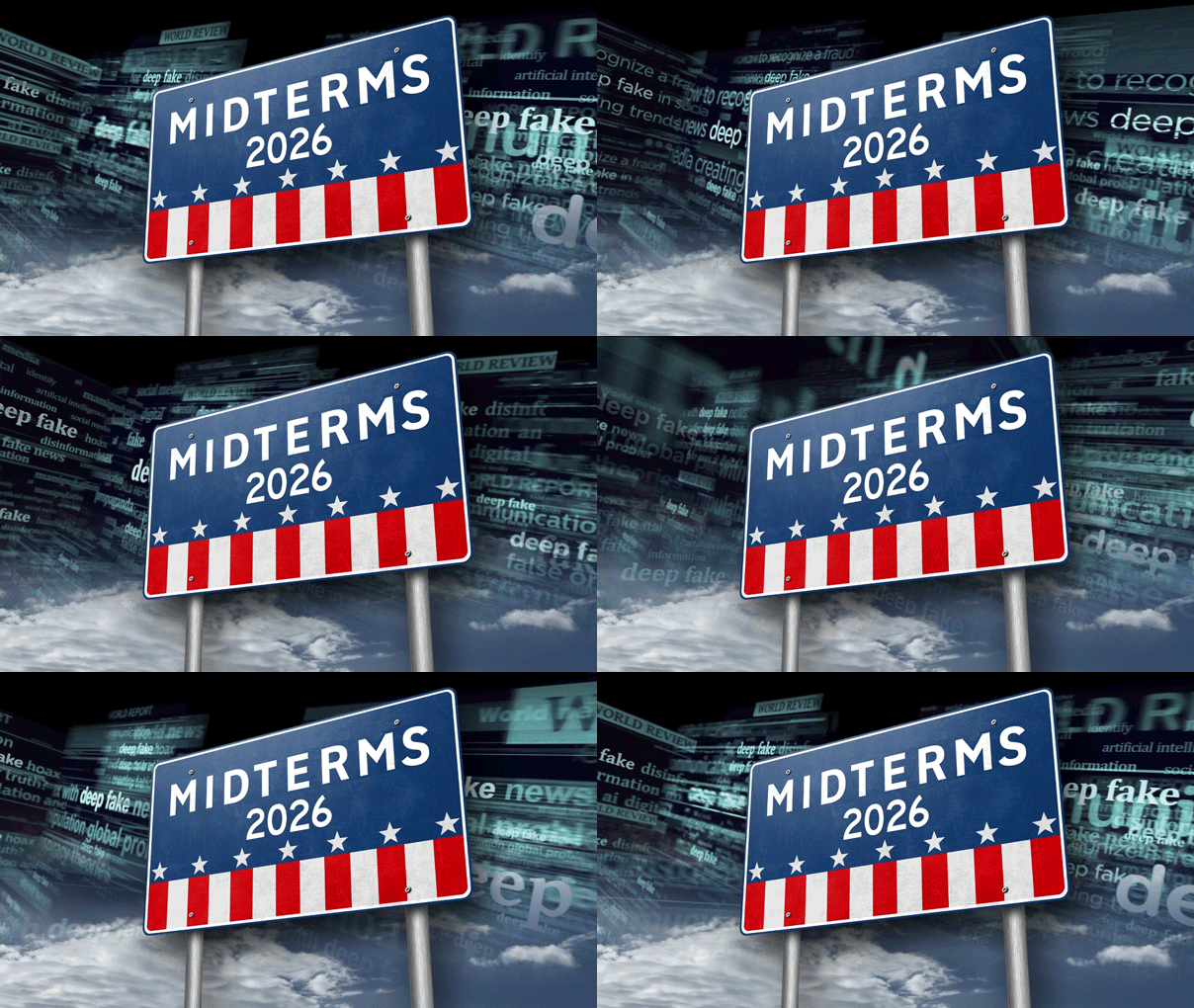
As the 2026 election cycle approaches, more campaigns are expected to adopt AI as a standard tool in their strategies.