Source: Fortune
Summary
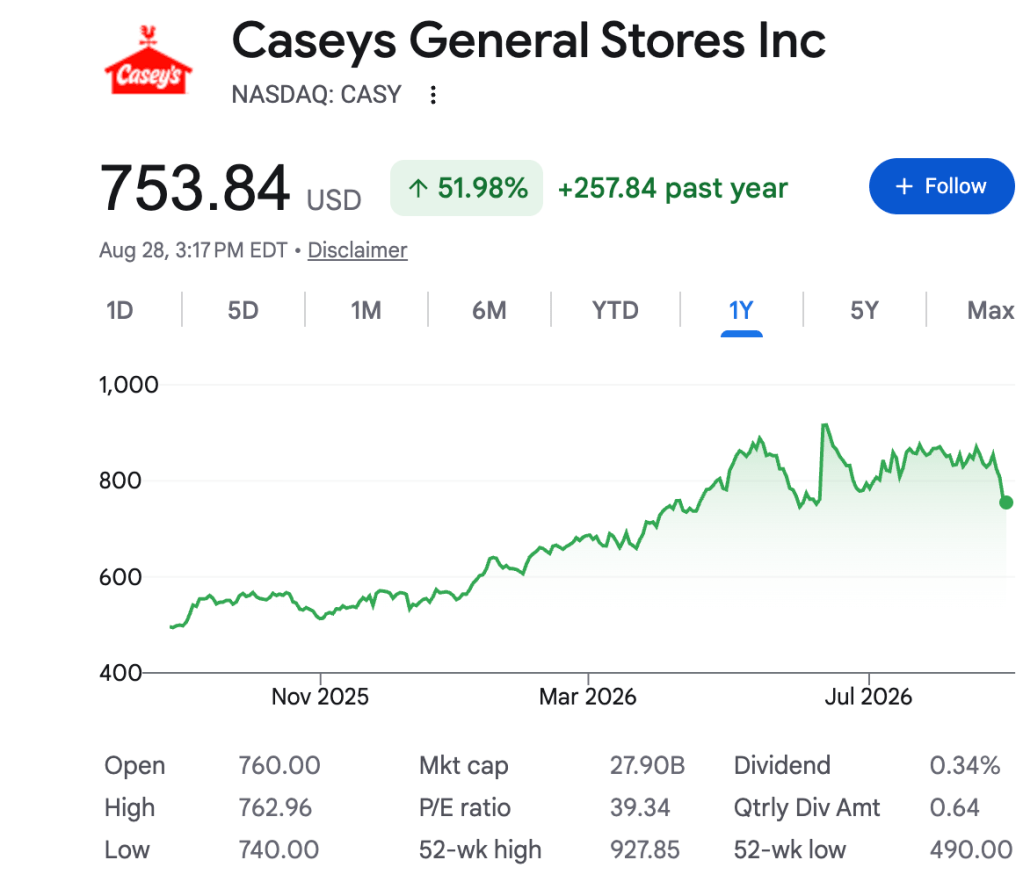
Casey’s, a convenience store chain with nearly 3,000 locations, is the fifth-largest pizza chain in the U.S. by prepared food and beverage sales, according to Bank of America. The company, which operates primarily in small towns, has seen its stock rise over 50% in the past year, reaching a $28 billion market cap. Casey’s pizza, including unique items like the taco pizza and breakfast pizza, has gained popularity, especially among younger generations. The company’s strategy focuses on small-town markets, where it has built a strong presence and brand loyalty. Casey’s also emphasizes affordability and quality, with food prices rising less than the industry average.
Our Reading
The numbers tell one story.
Casey’s has grown quietly but steadily, focusing on small towns where others don’t go.
Its pizza business is now a major driver of growth and brand recognition.
The company’s strategy is to be the go-to spot for food and convenience.
The original observation: A convenience store that’s also a pizza parlor is a formula that works when no one else is trying.
Author: Evan Null
A moat across small-town America
Casey’s origin traces back to 1968, when Donald Lamberti opened a converted service station in Boone, Iowa. Brennan said he’s talked to Lamberti about his strategy, describing it as, “Hey, this will probably work in the next small town.” He described a gradual, slow-and-steady, now explosive growth: “Literally, they just went from small town to small town, building Casey’s.” Over time, this became what Wall Street calls a “defensible moat,” because most other brands simply aren’t looking “to develop sites in towns that small.”
The company is still chasing the same bet that small is beautiful: build where the population is too small for anyone else to bother, and eventually you’re outcompeting Big Pizza on turf it never thought to conquer. Pizza joined the menu in 1984, and breakfast pizza about two decades later, what Brennan calls an “iconic” mix of sausage gravy, egg and cheese.
This strategy also means Casey’s is fighting a different war than its pizza competitors — if you consider them competitors. The roughly $31 billion quick-service pizza category turned negative in 2025, per Technomic, after barely growing the year before. The Wall Street Journal reported in January 2026 that America appeared to be “falling out of love with pizza.” Brennan said Casey’s was watching the trend closely, but the company has a different view.
“About half of our stores don’t have a national pizza competitor within what we consider a competitive rating,” he said. And when Casey’s does come to a nearby town, “we’re bringing something that hasn’t been really on offer there. And it’s resonating.”
Brennan added that Casey’s works to keep pizza and other key items priced slightly below the prevailing market rate. Citing inflation data, he noted that over the past three years, food away-from-home prices are up about 14%, while Casey’s prepared food and dispensed beverage business is only up 5%. “We can leverage the other parts of the business to make the total P&L work while we invest, essentially, to grow food.”
Math points to Casey’s next frontier: Texas
Math points to Casey’s next frontier: Texas. Iowa has about 3 million people and 550 Casey’s stores, he notes, while Texas has roughly 30 million people and room to run. “We see that as Casey’s country,” Brennan said, pointing to the small towns along the Interstate-35 corridor that don’t have anything like what Casey’s offers.
When asked if gas-station food is having a moment, Brennan said Casey’s is a Midwestern example of something that has been bubbling for decades in certain regions of the U.S. and spreading to others. He spent three years at 7-Eleven in the Mid-Atlantic a little over a decade ago, he added, and remembers how gas-station culture there turned into a rising tide, lifting all boats. His stores had the highest food sales in the enterprise in the U.S., not because of any underlying difference from other 7-Elevens, but “because Wawa and Sheetz had legitimized eating at a gas station.”
Brennan added that he serves on the retail board of the National Association of Convenience Stores and the “collegiality” of different brands is unique to convenience retail. “We certainly are supportive of each other,” he said. “We’re definitely in competition, but at the same time, the more good operators we have who really deliver delicious food in our channel, it lifts everybody up.”
When asked what his favorite Casey’s pizza was, he said breakfast pizza with bacon is hard to argue with, but a new item has caught his attention: the four-cheese pizza, which features a blend of provolone, mozzarella, cheddar — and then a special “post-bake shake” of cheese seasoning. “It is a game-changer.”
Casey’s social strategy and brand loyalty
Casey’s social team found its penetration with Gen Z has climbed 600 basis points over the past three years based on engagement. “What underpins all of this is just this incredible fandom and brand love that we’ve generated,” Brennan said. It all comes down to something an algorithm can’t fake, he added, an authenticity so beloved in the age of AI backlash and analog fever.
“It’s really built on decades of delivering high-quality pizza and food, a great experience.” Brennan argued that Casey’s is the “gathering spot” for its communities, and it keeps adding new features, like its Sauced Wings, which began as a pilot in January 2025 and have now grown to almost 900 stores, gradually rolling out across the chain over the next two years.
The company’s strategy of offering high-quality, affordable food in small towns has created a loyal customer base. This loyalty is evident in the growing presence of Casey’s on social media platforms like TikTok and YouTube, where the “gas-station pizza” genre has gained traction. Creators often highlight the quality of Casey’s pizza, praising its scratch-made dough and on-site ovens.
Brennan said he welcomes this exposure, as it helps bring more attention to the brand. The company’s focus on authenticity and community has helped it stand out in a crowded market. As Casey’s continues to expand, it’s clear that its unique approach is resonating with customers and investors alike.
Casey’s growth and expansion plans
Casey’s is expanding its presence in new markets, particularly in Texas, where it sees significant growth potential. The company’s strategy is to target small towns that are underserved by larger pizza chains. This approach has allowed Casey’s to build a strong presence in areas where other brands are not interested in operating.
The company’s expansion into Texas is part of a broader strategy to increase its market share and reach new customers. With a population of over 30 million, Texas offers a large and diverse market for Casey’s to tap into. The company is looking to leverage its existing model of serving small towns and expanding into new regions.
Casey’s is also investing in new products and services to enhance its offerings. The Sauced Wings, which were introduced in 2025, have been a success and are being rolled out to more locations. The company is also exploring other menu items that could appeal to its customers and help drive growth.
As Casey’s continues to grow, it’s clear that its focus on small towns and high-quality food is paying off. The company’s ability to adapt and innovate has helped it stand out in a competitive market. With its strong brand loyalty and expanding presence, Casey’s is well-positioned for continued success.