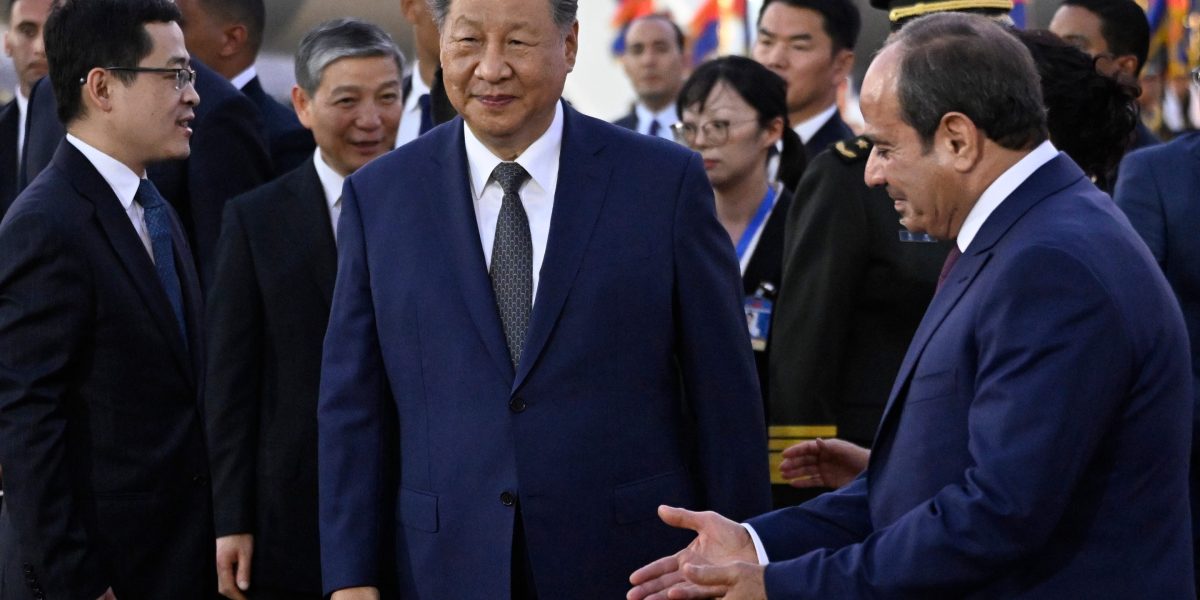
Source: Fortune.com
Summary
Chinese President Xi Jinping met with Egyptian President Abdel Fattah el-Sissi during a visit to Egypt, focusing on strengthening economic and diplomatic ties. The meeting comes as China seeks to expand its influence in the Middle East, a region where the U.S. has long been a dominant power. Xi emphasized cooperation against “unilateralism and acts of bullying” and called for a more equitable global governance system. Egypt views its growing relationship with China as a way to diversify its strategic partnerships, including joining the BRICS bloc and collaborating on the Belt and Road Initiative. Trade between the two countries reached $20 billion annually, while U.S.-Egypt trade was $15.7 billion in 2025.
Our Reading
The announcement sounds familiar.
Xi and el-Sissi talk about cooperation and global governance.
China builds soft power while the U.S. faces criticism.
Egypt diversifies its alliances, joining BRICS and working with China.
Trade numbers and strategic moves show a shift in regional influence.
China’s global ambitions are quietly reshaping alliances in the Middle East.
Author: Evan Null
Xi’s Visit to Egypt: A Strategic Move
Chinese President Xi Jinping’s visit to Egypt is more than a routine diplomatic meeting. It signals China’s growing interest in the Middle East, a region traditionally under U.S. influence. The visit comes amid a broader effort by Beijing to expand its global footprint, particularly as the U.S. faces challenges in maintaining its dominance. Egypt, a key player in the region, is seen as a strategic partner for China, offering access to the Suez Canal and a gateway to Africa and the Arab world.
China’s Soft Power and Global Ambitions
China is leveraging its economic and diplomatic ties to build soft power in the Middle East. By strengthening relationships with countries like Egypt, China aims to position itself as a stabilizing force in a region marked by conflict and shifting alliances. This approach contrasts with the U.S., which has been criticized for its military involvement and recent policy shifts. China’s investments in Egypt, including infrastructure projects and trade agreements, reflect its long-term vision for regional influence.
Egypt’s Strategic Diversification
Egypt has been actively diversifying its strategic partnerships, seeking to reduce its reliance on the U.S. and explore new alliances. The country’s invitation to join the BRICS bloc and its collaboration with China on the Belt and Road Initiative highlight this shift. Egypt’s leadership, including President el-Sissi, has emphasized the importance of maintaining strong ties with China, which has invested over $10 billion in the country. This investment includes the development of a business hub and an electric rail line, boosting Egypt’s economic prospects.
Regional Dynamics and Geopolitical Shifts
The Middle East is undergoing significant geopolitical changes, with China playing an increasingly prominent role. Beijing’s mediation between Iran and Saudi Arabia in 2023 demonstrated its growing influence in the region. However, recent tensions between the two nations have complicated this dynamic. Despite this, China continues to position itself as a mediator and a key player in regional stability. Its focus on the Suez Canal as an alternative to the Strait of Hormuz underscores its strategic interests in the area.
U.S. Challenges and China’s Rising Influence
The U.S. faces mounting challenges in maintaining its influence in the Middle East, including military engagements and shifting alliances. China’s growing presence in the region, coupled with its economic investments, presents a direct challenge to U.S. dominance. The Trump administration’s sanctions on Iran have further complicated the regional landscape, with China continuing to maintain significant trade ties with the Islamic Republic. As the U.S. grapples with these issues, China’s strategic moves in the Middle East are likely to shape the region’s future in the coming years.