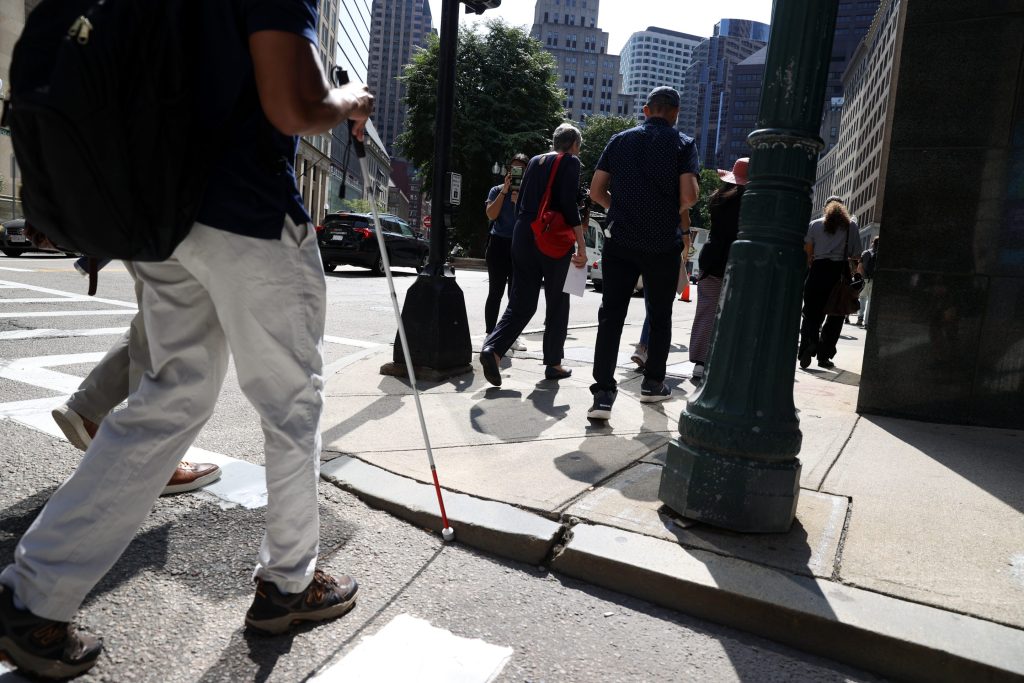
Source: Fortune
Summary
Coco Robotics, a startup operating 10,000 delivery robots, is partnering with BlindSquare to provide real-time sidewalk hazard data to visually impaired pedestrians. The data, collected by Coco’s robots, will be used to warn users of obstacles such as e-scooters and construction zones through spoken alerts. The partnership will go live in six cities across the US and Europe. Coco’s robots continuously log obstacles and update their sidewalk map, which will now be shared with BlindSquare. The app will convert the data into spoken alerts in 26 languages, warning users of hazards before they encounter them.
Our Reading
The numbers tell one story.
Coco Robotics’ partnership with BlindSquare is a strategic move to utilize the data collected by its delivery robots to improve navigation for visually impaired pedestrians. The company’s sidewalk map, updated in real-time, will provide valuable information to BlindSquare users. Coco’s CEO Zach Rash framed the partnership as an extension of the company’s existing infrastructure. The partnership also highlights the potential for robots to improve accessibility in cities.
Ilkka Pirttimaa, the founder of BlindSquare, noted that the partnership addresses a problem that has worsened with the increase in e-scooters. The app will provide a technological fix by sharing data on incorrectly parked e-scooters. The partnership is a step towards making cities more accessible for everyone.
The announcement sounds familiar. Coco’s partnership with BlindSquare is reminiscent of other companies exploring the use of technology to improve accessibility. The strategy enters a familiar phase.
Carl Hansen, Coco’s vice president of government relations, noted that cities often have outdated mapping data. Coco’s real-time data collection and sharing with BlindSquare will provide a more accurate and up-to-date picture of sidewalk hazards.
The partnership is a natural extension of Coco’s existing infrastructure, built for its own survival. The company’s mapping system works on tiered persistence, categorizing obstacles and assigning durations. The data will be used to improve navigation for BlindSquare users.
Rash pointed to the Abbot Kinney neighborhood in Venice Beach as an early proof of concept. The area’s old sidewalks were riddled with 14-inch curbs and missing curb cuts, making it inaccessible to anyone in a wheelchair or navigating without sight. Coco’s mapping data identified just three locations where installing curb cuts would unlock connectivity across the entire neighborhood.
The partnership hints at both BlindSquare and Coco’s broader ambitions for its sidewalk data. In Helsinki, they’re working with Swarco on a system where a robot waiting at an intersection could detect a crowd of pedestrians and dynamically extend the crossing time by communicating with smart traffic lights.
Robots were kind of opening roads to the blind user side.
Author: Evan Null