Source: Fortune
Summary
Grassroots opposition to automated license plate readers (ALPRs) has grown across the U.S., with cities canceling contracts and activists vandalizing the cameras. Flock Safety, a major provider, claims its technology helps reduce crime, but reports of misuse by law enforcement have fueled public distrust. In 36 states, people have taken direct action against ALPRs, citing privacy concerns. A historian draws parallels between the current backlash and the American Revolution, noting similar themes of resistance to surveillance and government overreach.
Our Reading
The numbers tell one story.
More than 130,000 ALPRs now operate in the U.S.
At least 5,000 agencies use Flock Safety cameras.
Public backlash has led to city contract cancellations and camera vandalism.
Historians see parallels to colonial resistance against British surveillance.
Author: Evan Null
Troublesome colonists
From the start, the English colonists of North America proved to be a thorn in the side of the government. Despite British hopes that investing in American colonies would enrich England, these ventures proved to be more costly than they were profitable. Colonists bore much of the blame.
When the British Parliament passed laws meant to regulate trade in the 1660s, colonists across the Eastern Seaboard turned to smuggling rather than comply. American merchants and consumers preferred to trade directly with both their fellow English colonists and merchants in the French and Dutch colonies rather than have that trade controlled by ministers in London.
The British government had little ability to enforce the law. This pattern of resistance and defiance would continue for decades, setting the stage for more direct confrontations with the Crown.
Colonists’ resistance to British control was not just economic but also political, as they sought greater autonomy and self-governance. This growing tension would eventually lead to open conflict.
Their actions, while often nonviolent, laid the groundwork for the revolutionary spirit that would define the American Revolution.
Britain pushes back
That changed in 1763, after British forces vanquished the French Empire from North America at tremendous cost. A new prime minister, George Grenville, led a series of reforms aimed at making the colonists pay for their own military protection.
Many Americans often believe that the Revolution began as a revolt against higher taxes. But most of the reforms coming from London actually lowered taxes to make smuggled goods less appealing.
What colonists really resented was the imperial government’s growing influence in their lives. In 1767, Parliament passed a series of laws that allowed Britain to raise revenue to pay the salaries of colonial governors, attorneys general and judges.
At the same time, Parliament sent troops to cities such as Boston to protect its officials. Competition for work and strained community relationships often led to violence between British soldiers and colonists.
The British response to colonial resistance was increasingly harsh, further fueling the colonists’ determination to resist.
American colonists turn to violence
The same year, angry colonists in Boston, New York and Philadelphia began boycotting British goods. Prominent Americans, including Benjamin Franklin and John Dickinson, endorsed these nonviolent protests.
But more radical leaders believed colonists needed to take more decisive action. On the night of Dec. 16, 1773, members of the paramilitary group the Sons of Liberty dumped nearly £10,000 worth of privately owned tea into Boston Harbor.
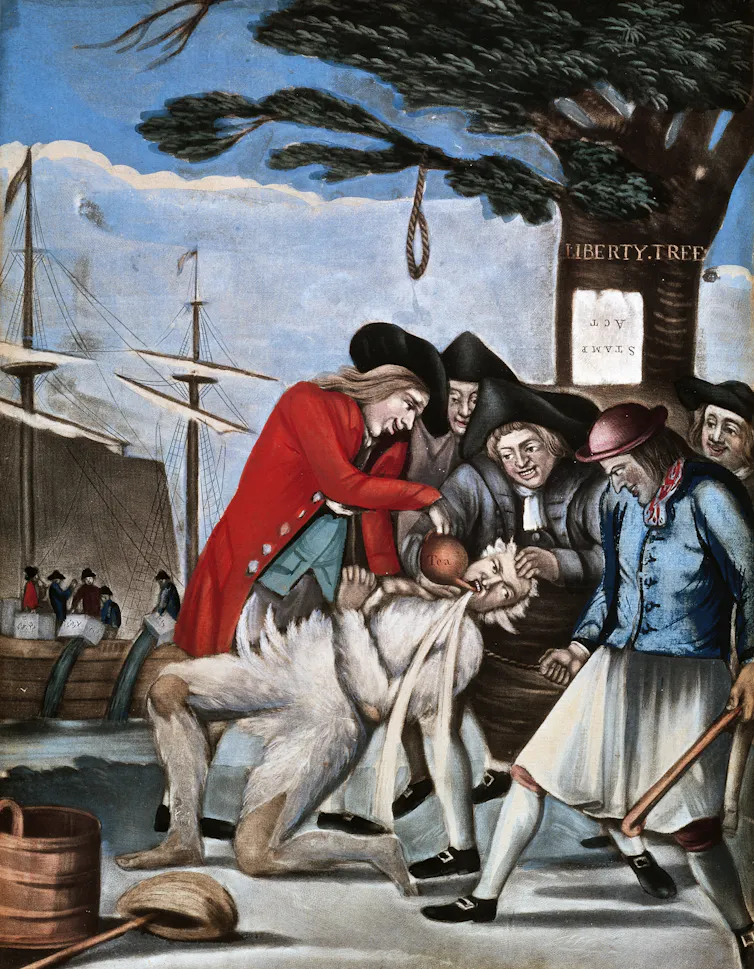
A few weeks later, the Sons of Liberty struck again. This time they attacked fellow colonist and British supporter John Malcolm, covering him in tar and feathers. Similar instances of destruction and violence occurred across the colonies.
The British responded harshly. In May 1774, Gen. Thomas Gage arrived at Boston as the colony’s new military governor. He implemented the so-called Coercive Acts, which closed the port of Boston and disbanded local government, among other measures.
The colonists’ resistance only grew in the face of British oppression, setting the stage for the eventual outbreak of the American Revolution.
Surveillance backfires
By early 1775, Boston was besieged. Around 5,000 British troops roamed the streets, directed by Gage to gather information on the Sons of Liberty and arrest leading dissidents.
Gage hoped heightened surveillance would quell unrest. But it only pushed more citizens into the radicals’ camp. On the night of April 18, 1775, a discrete network of watchmen eluded British surveillance and famously hanged two lanterns from the steeple atop Christ Church.
These beacons signaled that Gage’s troops were crossing the Charles River, on their way to seize colonial stores of gunpowder and ammunition, setting in motion the events that would begin the American Revolution.
In response to the widespread pushback to ALPRs, Flock Safety CEO Garett Langley appealed to history. In June 2026, he authored a post on the company’s website, arguing that detractors misunderstand Ben Franklin’s famous 1755 quote about liberty and safety.
Langley suggested Americans should prioritize safety and hoped Americans would be willing to “compromise” on issues of privacy, drawing parallels to the contemporary debate around ALPRs.
Historical parallels and modern resistance
Samuel Adams, one of the most prominent leaders of the Sons of Liberty, had his own opinion on compromise. Writing in June 1771, he explained that although Americans had “disagreed among themselves in one mode of opposition to arbitrary measures,” they were “united in the main principles of constitutional & natural liberty.”
Adams believed that, when threatened, American colonists would come together to defend their liberties. Clearly, Adams’ opinion resonates today.
The current backlash against ALPRs mirrors the resistance of colonial Americans to British surveillance and control. Both movements are driven by a deep concern for privacy and a refusal to accept what they see as overreach.
As with the American Revolution, the current pushback against ALPRs is not just about technology, but about the values and principles that define a free society.
The comparison highlights the enduring nature of the struggle between individual freedom and government power, a tension that continues to shape American history and politics today.