
Housing Affordability Crisis and Income Inequality
—
Source: Fortune.com
Summary
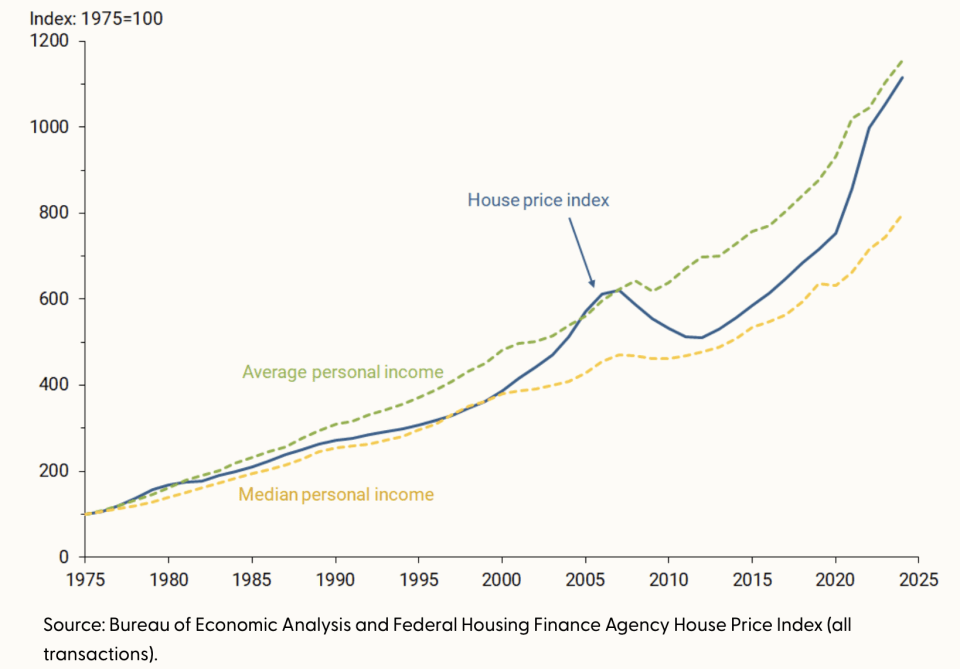
A recent economic note challenges the notion that increasing housing supply is the solution to the housing affordability crisis. The note by UC Irvine PhD student Schuyler Louie and San Francisco Fed researchers finds that average income growth relates strongly to house price growth, but there is almost no connection between average income growth and growth in housing supply. Instead, housing supply growth has a strong positive relationship with population growth.
Our Reading
The announcement sounds familiar.
Researchers have found that house prices and median income tracked each other closely until 2000, but after that, home price growth far surpassed incomes. This suggests that differences in income growth, particularly at the top of the distribution, may be driving housing affordability.
The study also found that when looking at average income, it grew essentially one-for-one with house prices from 1975 to 2024. This challenges the idea that regulatory reforms may have limited impact on housing affordability.
The researchers highlight the importance of understanding changes to the labor market, especially the relative distribution of economic growth across income levels and jobs in different areas, to address the housing affordability crisis.
This research indicates that regulatory reforms may have limited impact on housing affordability and that differences in housing supply constraints are not the fundamental drivers of differences in housing dynamics across metro areas.
Original observation: “The affordability crisis is often reframed as a supply problem, but this study reveals it’s actually a demand issue, driven by income inequality.”
