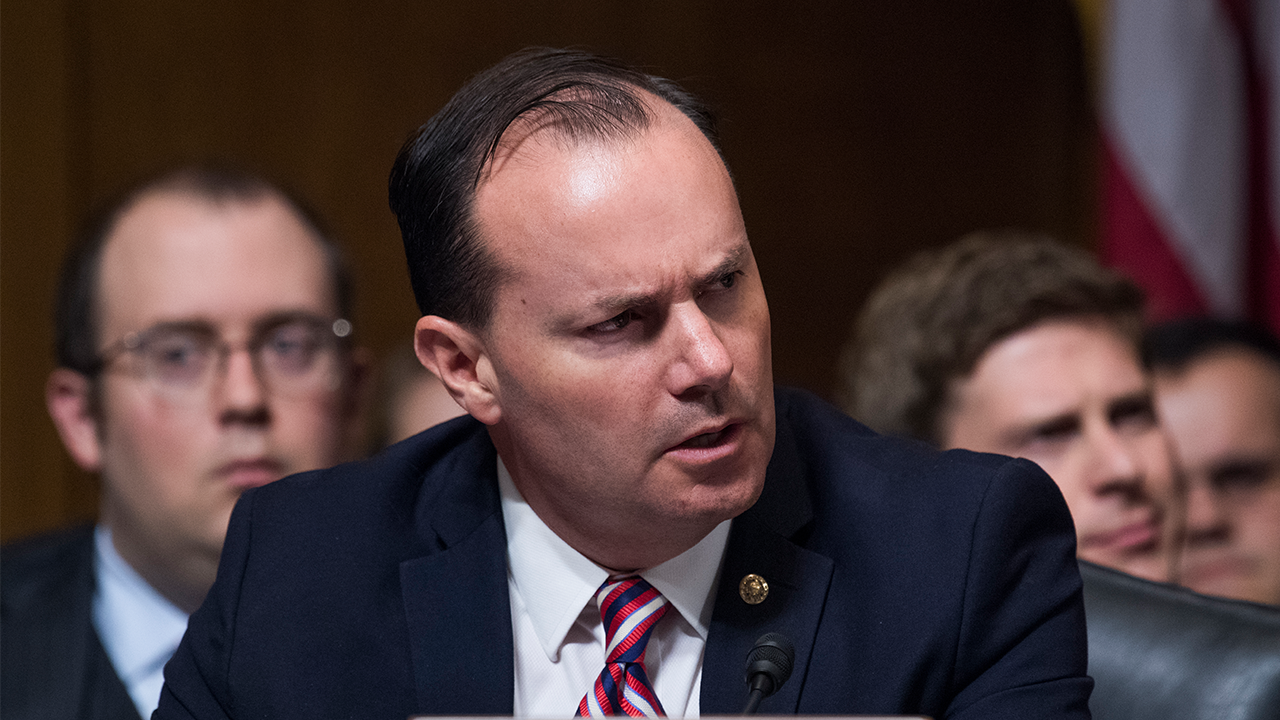
Source: Fox News
Summary
Sens. Mike Lee, R-Utah, criticized both Democrats and Republicans for resisting the SAVE America Act after a Reuters report found 30,000 noncitizens were mistakenly registered to vote in the U.S. since 2000. The report attributed the errors to software glitches and clerical mistakes, not organized fraud. Lee argued that current laws are hard to enforce and that voter fraud continues despite claims it does not exist. He compared voter registration to an Olive Garden policy requiring ID, saying it should be as strict. The bill, supported by Donald Trump, has passed the House but stalled in the Senate.
Our Reading
As expected, the matter has reached another stage.
Sen. Mike Lee speaks on the Senate floor.
He repeats claims about noncitizen voting.
He compares voter registration to a restaurant policy.
Errors in voter rolls become a familiar rallying point.
Author: Evan Null
Firebrand Conservative Sen. Mike Lee Slams Both Democrats and Republicans
Firebrand conservative Sen. Mike Lee, R-Utah, slammed both Democrats and Republicans who have resisted passage of the SAVE America Act after a report found that 30,000 noncitizens were “mistakenly” registered to vote in states across the country since 2000.
Reuters reported on Wednesday that more than 30,000 self-declared noncitizens were added to U.S. voter rolls since 2000. The outlet attributed the erroneous registrations to “software glitches and clerical errors” and said that its review suggested “inadvertent bureaucratic failures, rather than organized efforts to register immigrants illegally.”
However, while speaking on the Senate floor on Wednesday, Lee, who introduced the SAVE America Act earlier this year, said that “even though we have laws that prohibit things like noncitizen voting, those laws have been rendered difficult and essentially impossible to enforce.”
“That thing that they claim never happens, voter fraud or noncitizen voting, just keeps happening over and over and over again,” he railed.
Lee attributed problems with ineligible voter registration and voting to reliance on the “honor system” for self-attestation of voter eligibility.
Reuters Report on Voter Registration Errors
Reuters reported that the errors occurred in California, Illinois, Iowa, Nevada, Ohio, Oregon, Pennsylvania, South Dakota, Texas, Utah and Virginia. The outlet said it was unable to determine how many noncitizens actually cast ballots and further noted that the numbers are not precise because “state data is often tentative and subject to revision.”
This follows New Jersey Democratic Gov. Mikie Sherrill’s disclosure that 6,600 self-identified noncitizens were registered to vote and fewer than 400 of those individuals cast ballots.
Lee presented his SAVE America Act as a solution. President Donald Trump supports the bill, which passed the House but has stalled in the Senate.
Referencing an all-you-can-eat deal at a popular chain restaurant that requires customers to show I.D., Lee said that “it should not be any easier for someone to get away with voter fraud at a polling location on voting day than it is to cheat Olive Garden through its never-ending pasta pass.”
“And yet, that’s exactly where we are today,” he said.
Lee’s Argument for the SAVE America Act
Lee argued that the bill would address both ineligible voter registration and fraudulent voting by requiring registrants to verify citizenship and eligibility at the time of registration and requiring voter I.D. and photo identification at the polls.
In an interview with Fox News Digital, Don Palmer, senior legal fellow for election integrity at the Heritage Foundation, said that “this story really provides proof that one way forward is to simply upgrade and sort of help the driver’s license agencies across the country improve their verification of citizenship while they’re providing those services to voters.”
“All joking aside with the Olive Garden scenario, I love their food and I’m more than happy to show the I.D., I think the issue is I wish that the driver’s license agencies and state agencies would take voter registration as serious as Italian food,” he quipped.
“I think that that would be a bipartisan way of improving that verification of citizenship with databases, and I think there’s some bipartisan support for that. And so that might be a way forward, not necessarily, showing documentation of citizenship, but let’s improve the driver’s license agencies to verify citizenship, and let’s improved real ID,” he said.
Impact of the Report and Political Reactions
The report has sparked renewed debate over voter fraud and registration processes. Lee has been a vocal advocate for stricter voter ID laws and has criticized the current system for allowing noncitizens to register to vote.
Despite the report, some officials and experts have argued that the number of noncitizens voting is minimal and that the errors are not indicative of widespread fraud.
Lee’s comments reflect a broader political strategy that emphasizes voter fraud as a significant issue, even as evidence of large-scale fraud remains limited.
The debate over the SAVE America Act highlights the ongoing tension between election security and voter access, with both sides presenting different interpretations of the data and its implications.
Broader Implications for Election Policy
The report and Lee’s response underscore the political significance of voter registration errors and the potential for such issues to influence public perception and policy decisions.
While the numbers of noncitizens registered to vote are relatively small, the issue has become a focal point for conservative lawmakers seeking to push for stricter voting laws.
The debate also reflects broader concerns about the integrity of the voting process and the role of state and federal agencies in ensuring accurate voter rolls.
As the political landscape continues to evolve, the discussion around voter fraud and registration will likely remain a contentious and influential topic in future elections.