Source: Fortune
Summary
Tech stocks faced pressure amid speculation around CoreWeave’s debt, but traders bought the dip, leading to global stock gains. The S&P 500 rose 0.33%, while the equal-weight S&P gained 1.36%. The Nasdaq remained flat. Fed Chair Kevin Warsh’s speech did not signal an interest rate hike, easing investor concerns. Energy stocks saw a 50% gain year-to-date, driven by demand from AI data centers and rising oil prices.
Our Reading
The numbers tell one story.
Tech stocks were under pressure but recovered.
Investors rotated into non-tech sectors.
Warsh’s speech avoided hawkish signals.
Energy stocks hit a 50% gain for the year.
The market’s calm after a volatile stretch is a familiar pattern.
Investors are looking for stability after a rocky period.
The Fed’s lack of guidance is seen as a positive.
Energy stocks are benefiting from multiple tailwinds.
Rotation out of tech is a recurring theme.
The original observation: A market that recovers after a sell-off is always a sign of underlying confidence.
Author: Evan Null
Market Volatility and Investor Behavior
After a period of intense pressure on tech stocks, the market showed signs of recovery. Traders who had been selling off during the downturn began buying the dip, leading to a broad-based rise in global stock indices. This shift in investor sentiment highlights the cyclical nature of financial markets, where periods of fear are often followed by a return to optimism.
The S&P 500 saw a modest gain of 0.33%, while the equal-weight S&P 500 performed much better, rising 1.36%. This divergence suggests that the market is not only recovering but also shifting its focus away from the tech sector. The Nasdaq, which is heavily weighted toward tech stocks, remained flat, indicating that the sector is still under pressure.
Investor behavior during this period reflects a broader trend of risk aversion and a search for stability. With the Federal Reserve not signaling a rate hike, investors are more inclined to take on risk, leading to a rotation into non-tech sectors. This shift is seen as a positive development, even if it is uncomfortable for those who have been heavily invested in tech stocks.
The energy sector has been a standout performer, with gains of 50% year-to-date. This surge is driven by increased demand from AI data centers and rising oil prices. The energy sector’s performance underscores the importance of external factors in shaping market dynamics, as well as the role of macroeconomic trends in influencing investor decisions.
Overall, the market’s response to recent events highlights the complex interplay between investor sentiment, macroeconomic conditions, and sector-specific performance. As the market continues to evolve, the focus remains on stability, growth, and the ability of different sectors to adapt to changing conditions.
Central Bank Influence and Market Expectations
The Federal Reserve’s role in shaping market expectations is evident in the recent performance of financial assets. Fed Chair Kevin Warsh’s speech at the IMF did not include any signals of an upcoming interest rate hike, which was a relief for investors. This lack of forward guidance from Warsh, combined with previous remarks from other Fed officials, has led to a decline in expectations for a rate increase in October.
The CME FedWatch futures indicate an 85% probability that the Fed will hold rates steady in the coming month. This expectation is favorable for stock investors, as stable interest rates mean lower borrowing costs and a more predictable economic environment. The market’s reaction to this news shows that investors are sensitive to central bank communication and are quick to adjust their strategies based on new information.
Despite the lack of a clear signal from Warsh, the market has interpreted his remarks as a sign of caution. This interpretation aligns with the statements made by other Fed officials, such as New York Fed President John Williams, who has also signaled a more dovish stance. The consistency in messaging from different Fed officials reinforces the idea that the central bank is not in a hurry to raise rates, which is a positive development for the broader market.
The influence of the Federal Reserve on market expectations is a key factor in determining investor behavior. When central banks provide clarity or reassurance, it can lead to a more stable and predictable market environment. In this case, the Fed’s lack of a hawkish stance has helped to ease investor concerns and support a broader market recovery.
As the market continues to react to central bank communications, it is clear that investor sentiment is closely tied to the Fed’s actions and statements. The recent performance of financial assets suggests that the market is responding positively to the Fed’s current approach, which is focused on maintaining stability rather than pursuing aggressive policy changes.
Global Market Trends and Regional Performance
The global market response to recent events has been mixed, with different regions showing varying degrees of strength. In the U.S., S&P 500 futures were up 0.42% in early trading, reflecting a positive outlook for the market. The index had already gained 0.33% the previous day, indicating a sustained upward trend. This performance suggests that investors are becoming more confident in the market’s ability to recover from recent volatility.
In Europe, the Stoxx 600 index rose 0.46% in early trading, while the U.K.’s FTSE 100 remained flat before lunch. This divergence highlights the different economic conditions and investor sentiment across European markets. The Stoxx 600’s performance suggests that European investors are also beginning to see signs of recovery, while the FTSE 100’s flat performance indicates that the U.K. market is still cautious.
In Asia, the market showed strong performance, with South Korea’s Kospi rising 2.05%, Japan’s Nikkei 225 up 1.39%, and India’s Nifty 50 gaining 0.36%. China’s CSI 300 also saw a modest increase of 0.11%. These gains reflect the growing confidence in Asian markets, which have been benefiting from strong economic growth and favorable macroeconomic conditions.
The global market’s performance is influenced by a variety of factors, including economic data, geopolitical events, and central bank policies. The recent gains in Asian markets suggest that investors are looking for opportunities in regions with strong growth potential. At the same time, the mixed performance in Europe and the U.S. indicates that investors are still cautious and are carefully evaluating the risks and rewards of different markets.
Overall, the global market’s response to recent events shows that investors are beginning to see signs of recovery, but they remain cautious. The performance of different regions highlights the importance of understanding local economic conditions and investor sentiment when making investment decisions.
Commodity Markets and Investor Sentiment
The performance of commodity markets has also been influenced by recent events, with Brent crude oil rising to $105 per barrel. This increase reflects the ongoing demand for energy, driven by factors such as the growth of AI data centers and the continued demand for oil. The rise in oil prices has had a positive impact on energy stocks, which have seen significant gains in recent months.
Bitcoin, another key asset in the financial markets, was trading at $82,101. This level reflects the ongoing interest in digital assets, despite the volatility associated with the cryptocurrency market. The performance of Bitcoin is closely watched by investors, as it is often seen as a barometer of market sentiment and risk appetite.
The rise in commodity prices and the performance of Bitcoin highlight the broader trend of investors seeking alternative assets to diversify their portfolios. As traditional markets face uncertainty, investors are turning to commodities and cryptocurrencies as potential sources of growth and stability. This shift in investor behavior underscores the importance of diversification in a rapidly changing financial landscape.
Commodity markets are also influenced by macroeconomic factors, such as inflation, interest rates, and geopolitical events. The recent performance of Brent crude and Bitcoin suggests that investors are reacting to these factors by adjusting their portfolios to reflect changing market conditions. This dynamic environment requires investors to stay informed and adaptable in order to make informed decisions.
As the financial markets continue to evolve, the performance of commodities and cryptocurrencies will remain a key area of focus for investors. These assets offer unique opportunities and risks, and their performance is closely tied to broader economic and market trends.
Corporate Performance and Sector-Specific Trends
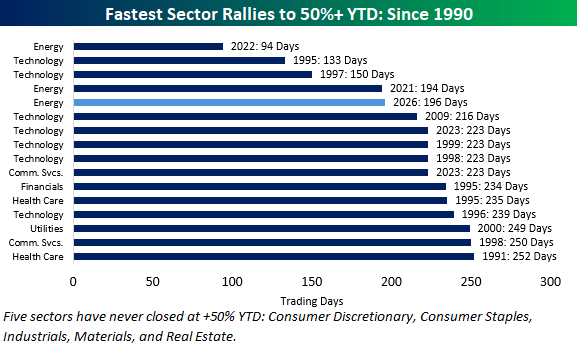
The energy sector has been a standout performer this year, with stocks in the S&P 500’s energy sector gaining 50% year-to-date. This performance is driven by a combination of factors, including increased demand from AI data centers and rising oil prices. The energy sector’s strong performance highlights the impact of macroeconomic trends on individual sectors and the importance of understanding these dynamics when making investment decisions.
This year’s rally in the energy sector ranks as the fifth among all 50% sector gainers since 1990, according to Bespoke Investment Group. This historical context provides valuable insight into the current performance of the energy sector and suggests that the sector is experiencing a significant and sustained upward trend. The performance of the energy sector is also influenced by broader economic conditions, such as inflation and interest rates, which can impact the demand for energy and the cost of production.
The energy sector’s strong performance is not isolated but is part of a broader trend of sector-specific gains. As investors look for opportunities in different parts of the market, they are increasingly focusing on sectors that are benefiting from favorable conditions. The energy sector’s performance is a clear example of how macroeconomic and industry-specific factors can drive stock performance and investor sentiment.
The rise in energy sector stocks also reflects the growing importance of energy in the global economy. As AI data centers and other energy-intensive industries continue to expand, the demand for energy is likely to remain strong. This trend is expected to continue, which could lead to further gains for energy stocks in the coming months.
Overall, the energy sector’s performance highlights the importance of understanding the factors that drive sector-specific gains. As the market continues to evolve, investors will need to stay informed about the trends and conditions that are shaping different sectors and their performance.