Source: Fortune
Summary
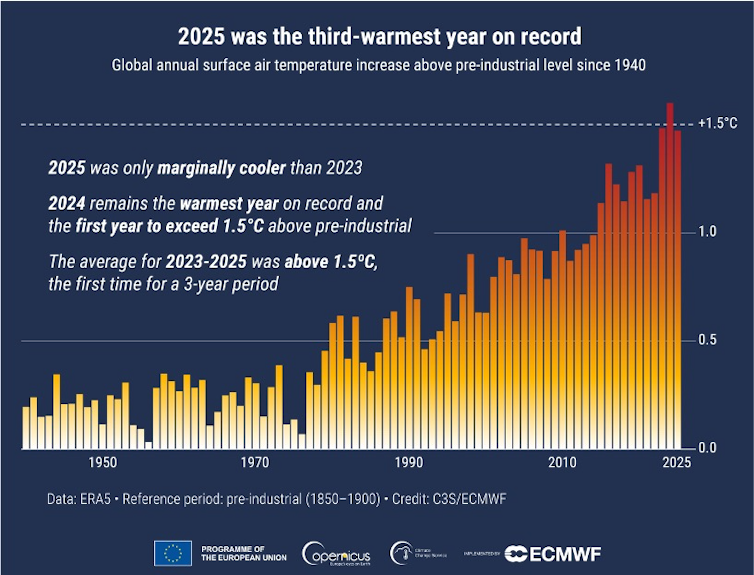
The past three years have been the world’s hottest on record, with 2025 being the third-hottest year in over 175 years. Despite factors that should have made 2025 cooler, such as La Niña and a decline in solar energy, the year still ended up being warmer than expected. Greenhouse gas emissions, Earth’s energy imbalance, and air pollution are among the factors that contributed to the increased temperature. Climate models predict 2026 to be as hot as 2025, with a 60% chance of a Pacific El Niño developing.
Our Reading
The numbers tell one story. 2025 was the third-hottest year on record, despite La Niña and a decline in solar energy. Greenhouse gas emissions and Earth’s energy imbalance are driving the warming trend. The planet is already starting 2026 out warm, with January being the fifth-warmest on record. The International Energy Agency expects global electricity demand to increase by 3.6% per year through at least 2030. The “dirty surprise” is that air pollution, which has been masking the full effects of human-caused greenhouse gases, is decreasing, leading to a 0.2 F (0.13 C) increase in global temperatures.
The Conversation, a platform that publishes articles by academics and experts, republished the original article from Fortune. The article was written by Michael Wysession, a Professor of Earth, Environmental, and Planetary Sciences at Washington University in St. Louis.