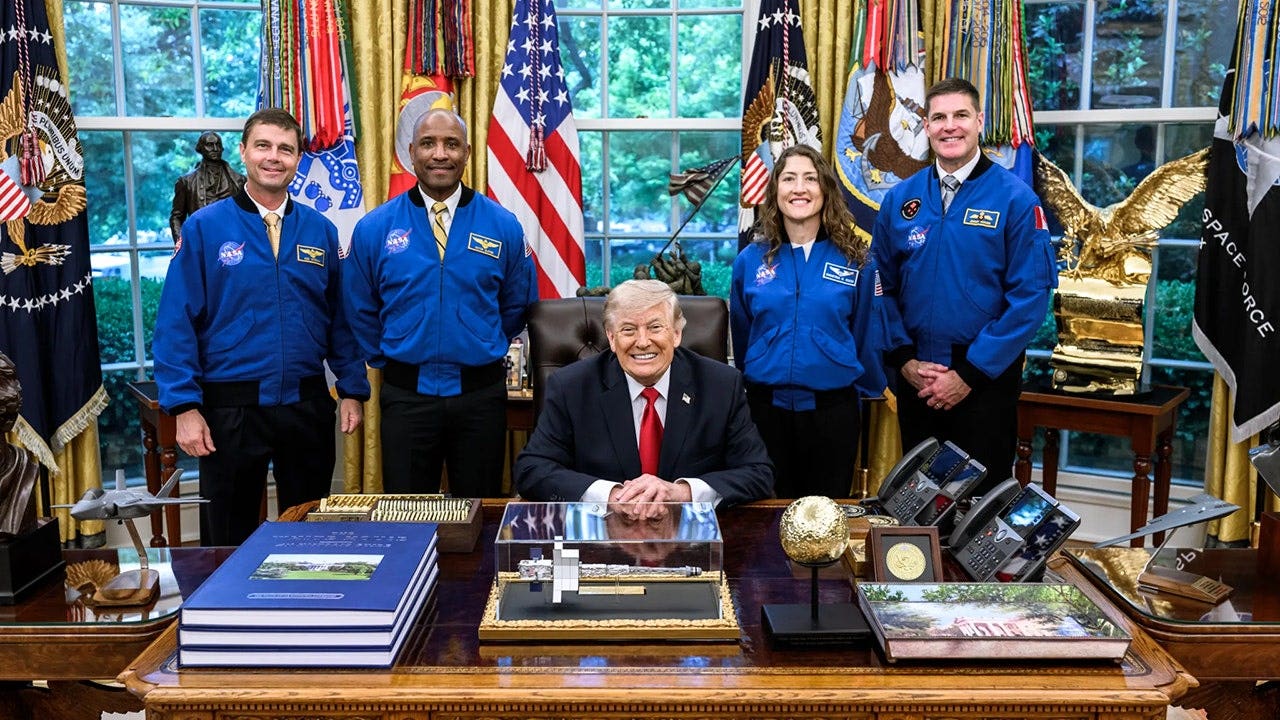
Source: Fox News
Summary
President Donald Trump will honor four astronauts who traveled farther from Earth than any humans in history during the Artemis II mission. The astronauts—Reid Wiseman, Victor Glover, Christina Koch, and Jeremy Hansen—will receive the Congressional Space Medal of Honor on August 28 at NASA’s Johnson Space Center. The mission, which took place in April, marked the first crewed flight of NASA’s Orion spacecraft and the first lunar orbit in over 50 years. The crew reached a distance of 252,756 miles from Earth, surpassing the Apollo 13 record. The mission tested Orion’s systems and gathered data for future lunar missions.
Our Reading
As expected, the matter has reached another stage.
Trump will stand before astronauts, medals in hand, as the nation watches.
The astronauts, once in space, now stand on Earth, receiving recognition.
The moon, once distant, now serves as a stage for political gestures.
The ceremony feels like a repeat of past celebrations, just with new names.
Author: Evan Null
Artemis II and the Space of Recognition
The Artemis II mission, a historic journey around the moon, has now become a moment of political ceremony. The astronauts, who once traveled far from Earth, now return to a familiar setting—Washington, D.C.—to receive a medal. The event, scheduled for August 28, highlights how space achievements are not only scientific milestones but also political performances. The medal, a symbol of honor, has been awarded to only a select few, including Apollo-era astronauts. The ceremony, like many before it, serves as a reminder of the nation’s space ambitions and the role of leadership in shaping them.
The Moon as a Stage for Politics
The Artemis II mission, which took place in April, was a significant step in NASA’s plan to return humans to the moon. The astronauts, who traveled farther than any before them, now find themselves in the spotlight once more. The Congressional Space Medal of Honor, awarded by the president, is not just a personal honor but a public acknowledgment of national achievement. The event, set to take place at NASA’s Johnson Space Center, is a ritual that reinforces the connection between space exploration and political leadership.
From Space to Ceremony
The astronauts, who once faced the unknown of space, now face the known of ceremony. The medal they receive is a symbol of their bravery and the risks they took. It also serves as a reminder of the nation’s commitment to space exploration. The ceremony, like many others before it, follows a familiar pattern—heroic deeds, public recognition, and political symbolism. The moon, once a distant goal, now becomes a backdrop for political performances.
Recognition as a Routine
Space achievements, once seen as groundbreaking, now become routine in the eyes of the public. The Artemis II mission, which marked a significant step in NASA’s lunar ambitions, is now being celebrated with a ceremony. The astronauts, who once traveled far from Earth, are now being honored in a setting that feels expected. The medal, a symbol of distinction, is awarded in a way that feels familiar, almost predictable. The event, like many others, serves as a reminder of the nation’s ongoing space efforts.
The Ritual of Honoring Space Heroes
The ceremony for the Artemis II astronauts is not just a celebration of their journey but also a reaffirmation of national priorities. The medal they receive is a token of recognition, but it also serves as a political statement. The event, set to take place in Houston, is a ritual that has been repeated many times before. The astronauts, once in space, now stand on Earth, receiving the same kind of honor that has been given to previous generations of space explorers. The moon, once a symbol of exploration, now becomes a stage for political gestures.