Source: Fortune
Summary
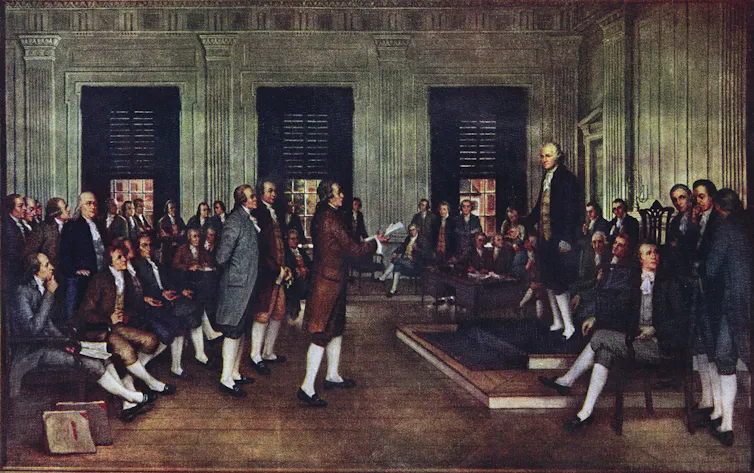
The 250th anniversary of the Declaration of Independence has passed, but the document was only the first step in creating a unified country. The founders argued that the country needed a remodeled government to ensure liberty despite human nature’s flaws. The Articles of Confederation, the first constitution, was a loose confederation of state governments with limited powers. The government faced social and political issues, including extensive debts, rebellions, and economic depression. The Constitutional Convention in 1787 drafted the United States Constitution, which included a stronger central government, a three-part federal government, and expanded powers. The Federalist Papers, written by Alexander Hamilton, James Madison, and John Jay, defended the Constitution and proposed institutional solutions to control human nature’s destructive drives.
Our Reading
The numbers tell one story.
The Federalist Papers reveal a skeptical view of humanity, acknowledging the flaws of human nature and the need for a strong government to control them. The founders, including Hamilton, Madison, and Jay, believed that human nature is susceptible to corruption by base impulses and self-interest. They proposed institutional solutions to redirect these impulses toward positive social ends, creating a balanced government to control the destructive drives of individuals. The Federalist Papers framed the new government in terms of this skeptical view, recognizing a degree of depravity in mankind, but also asserting that constitutional design and balanced government could control these impulses.
The authors of the Federalist Papers were aware that the new government would face challenges, including the potential for uprisings and fiscal policy issues. They believed that a strong central government was necessary to enforce laws and maintain order, and that the Constitution provided the framework for this.
In the end, the Federalist Papers provide a unique insight into the founders’ views on human nature and the role of government in controlling its flaws.
Author: Evan Null