Source: Fortune
Summary
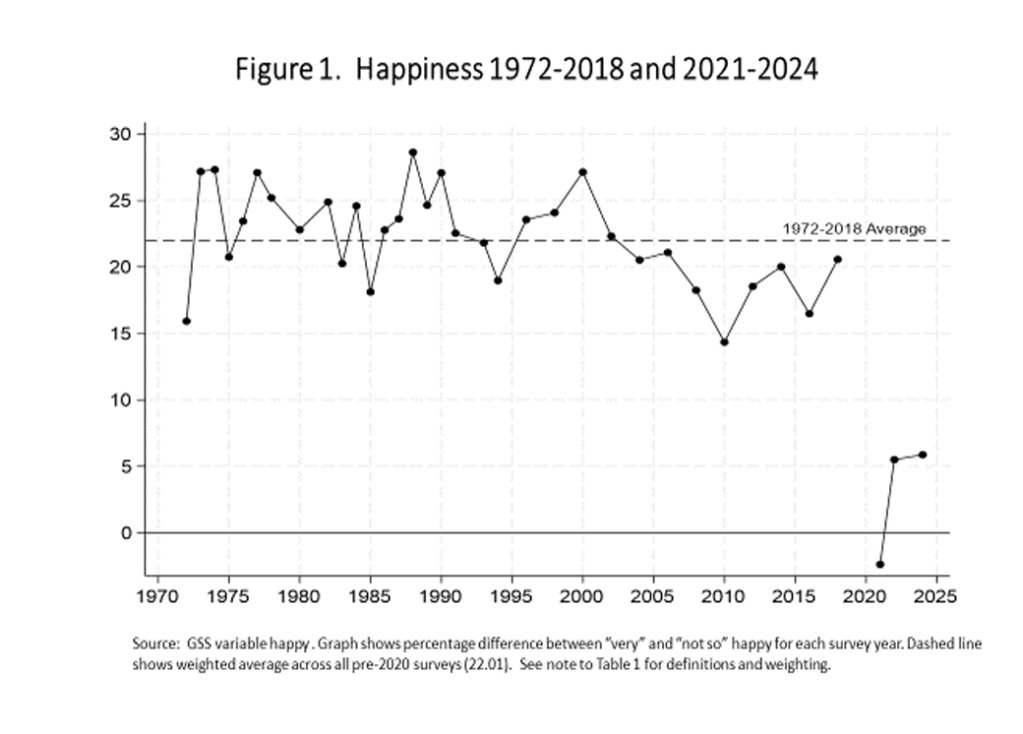
A study by economist Sam Peltzman found that Americans are at their least happy point in the 50-year history of the General Social Survey. The survey asks a simple question: “Are you happy?” Peltzman’s measure, the percentage of people saying “very happy” minus those saying “not very happy,” has declined significantly since 2020. The decline is attributed to the “aspiration gap,” where people’s expectations are not met, leading to dissatisfaction. The study also found that the married are still reasonably happy, while the unmarried are significantly less happy. The aspiration gap is a result of a society that raised everyone’s expectations and then made them feel permanently out of reach.
Our Reading
The numbers tell one story.
Sam Peltzman’s research has found a significant decline in happiness among Americans, with the married being more resilient than the unmarried. The aspiration gap is a key factor, where people’s expectations are not met, leading to dissatisfaction. The study’s findings suggest that the institution of marriage is still a reliable anchor for identity and status, but it is in long-term decline. The experience economy has emerged as a coping mechanism, with people investing in experiences rather than material possessions.
The aspiration gap is a result of a society that raised everyone’s expectations and then made them feel permanently out of reach. The goalposts have moved, and the definition of the American Dream has changed. Lower-income Americans now define the dream as stability, while the affluent still define it as opportunity.
The study’s findings suggest that the world is different, and that the charts showing the line going up are not lying, but they are not telling the whole truth either. The people who run the institutions Americans inhabit day-to-day have their own answers to closing the aspiration gap, including relational, financial dignity, and emotional connectivity.
The aspiration gap doesn’t close from the top down, it closes, if it closes at all, from the inside out — through institutions, relationships, and communities that make people feel like their position in the world is real, respected, and connected to something beyond a chart.
The GSS is in the field right now, and Peltzman is watching for the next set of numbers. Unless the next set of numbers comes in with a return to the norm, the world is different.
Author: Evan Null