Source: Fortune
Summary
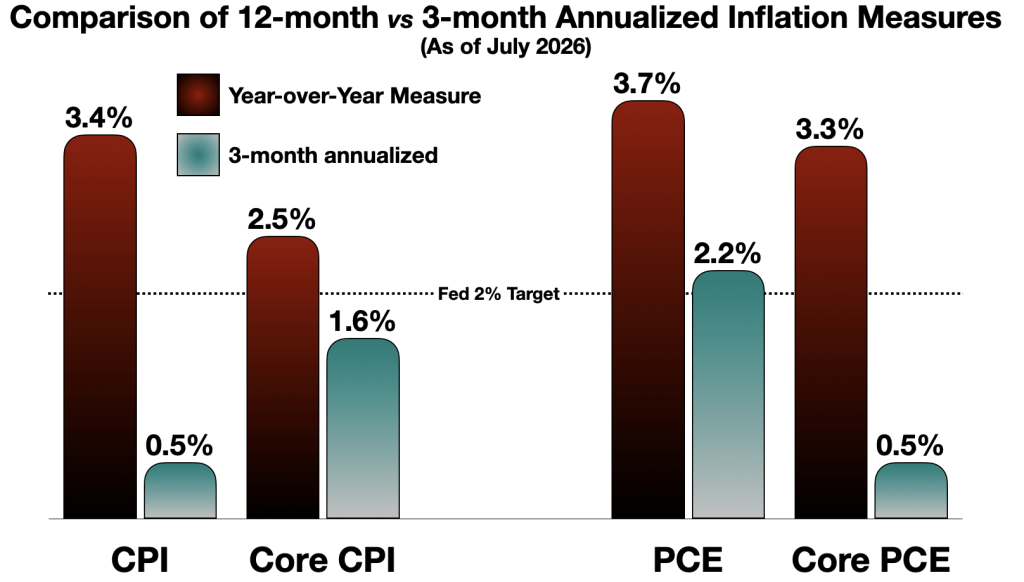
The Federal Reserve has been criticized for relying on year-over-year inflation data, which can lag behind current economic conditions. July’s CPI rose 3.4%, still above the Fed’s 2% target, but a three-month average shows a much lower 0.49% annualized rate. Fed officials like Beth Hammack and Neel Kashkari expressed concerns about persistent inflation, while others, like Lorie Logan, were more pessimistic. The Producer Price Index also showed mixed signals, with monthly declines in June and July. Inflation expectations have fallen, with market measures forecasting 2.3% inflation. Some economists argue that shorter-term data provides a more accurate picture of inflation trends.
Our Reading
The numbers tell one story.
The Fed relies on year-over-year data, which lags current trends.
Short-term measures show a much lower inflation rate than the headline CPI.
Officials express concern, but market signals suggest inflation is cooling.
The Fed may be reacting to outdated data, not current conditions.
Author: Evan Null
Why the Fed Is Often Slow, Late, and Wrong in Reading Inflation
The Federal Reserve has long been criticized for its reliance on year-over-year (YoY) inflation data, which is seen as outdated and slow to reflect current economic conditions. This method of measuring inflation, which looks at the past 12 months, can obscure the true state of the economy, especially when rapid changes occur. For example, the July Consumer Price Index (CPI) came in at 3.4%, slightly below the 3.5% in June, but still well above the Fed’s 2% target. However, a three-month average of the CPI shows a much lower annualized rate of 0.49%, suggesting a different picture of inflation.
Despite these mixed signals, some Fed officials remain concerned about inflation. Beth Hammack, president of the Cleveland Fed, warned that prolonged high inflation could become entrenched, while Neel Kashkari of the Minneapolis Fed projected multiple rate hikes. Lorie Logan of the Dallas Fed also expressed pessimism. However, market expectations have shifted, with traders betting less on a September rate hike and more on a potential pause. This shift suggests that the market is reacting to more current data, rather than the Fed’s traditional metrics.
The Producer Price Index (PPI) also shows a mixed picture. While the PPI rose 4.7% year-over-year, the monthly data has been falling rapidly since April, with negative readings in June and July. The three-month annualized rate is 1.6%, which is significantly lower than the YoY figure. Inflation expectations have also moderated, with both market measures and the Cleveland Fed’s 1-year model forecasting inflation around 2.3%, well below the headline CPI.
Economists and former Fed officials have long argued that shorter-term data provides a more accurate view of inflation. Nobel laureate Paul Krugman and former Council of Economic Advisors Chair Jason Furman both support using three- to six-month averages instead of YoY data. Former Fed Chair Jerome Powell and Vice-Chair Lael Brainard have also referenced shorter-term inflation measures. The Cleveland Fed even publishes an “inflation nowcast” using a three-month annualized CPI, currently at 1.05%.
The reliance on backward-looking data has led to a lag in the Fed’s response to inflation. The inflation spike of 2021-2023 was only addressed after it had already begun to decline, with rate hikes starting in mid-2022. By the time the Fed acted, the inflationary surge was already ending. This delay has raised concerns about the effectiveness of monetary policy and the potential for over-tightening in the current environment. With the labor market weakening and economic uncertainty high, some argue that the Fed is reacting to outdated data rather than current conditions.