Source: Fortune.com
Summary
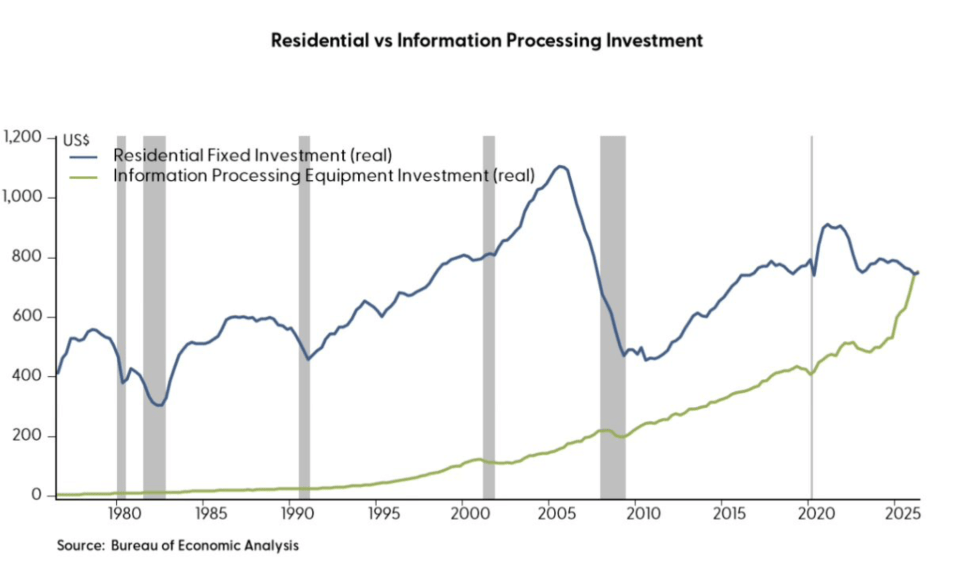
Spending on information processing equipment, including data centers, has surpassed residential investment in the U.S., according to the San Francisco Fed. Real private residential fixed investment fell to $748 billion in the second quarter, down 18% from a 2021 peak, while spending on information processing equipment rose 51% to $752 billion. Adam Shapiro of the San Francisco Fed noted the shift in investment from housing to technology. AI-related capital expenditures are expected to exceed $1.3 trillion in 2027, up from $470 billion in 2025, according to S&P Global. The report warned of potential overcapacity if demand does not meet expectations.
Our Reading
The numbers tell one story.
Residential investment is down, while tech spending is up.
AI capital expenditures are rising fast.
Hyperscalers are spending more than they earn.
The shift is clear, but the risks are real.
Investment is moving where the returns are, even if the math doesn’t add up yet.
Author: Evan Null
AI Spending Surpasses Housing Investment
Two decades after the housing boom reshaped the U.S. economy, the AI boom is now driving growth. Hyperscalers are investing heavily in AI infrastructure, with capital expenditures expected to reach $1 trillion annually. This shift is evident in the data, with spending on information processing equipment now exceeding residential investment. The San Francisco Fed’s Adam Shapiro highlighted this pivotal change, noting that investment is moving away from housing and toward technology.
Residential Investment Slumps
Residential investment has been declining since 2022, when the Federal Reserve began raising interest rates to combat inflation. Real private residential fixed investment dropped to $748 billion in the second quarter, down 18% from its peak. The 30-year mortgage rate has climbed to nearly 7%, making home buying less accessible. This decline contrasts with the surge in AI spending, which has grown 51% to $752 billion during the same period.
AI Investment Less Sensitive to Rates
Unlike housing, AI investment has been less affected by rising interest rates. Hyperscalers are issuing more debt to fund their AI projects, even as borrowing costs rise. Google’s parent company, Alphabet, reported negative cash flow earlier this year. Treasury Secretary Scott Bessent noted that AI companies are willing to take on debt regardless of cost, believing in the high returns from AI development.
Corporate Issuance and Overcapacity Risks
S&P Global estimated that AI-related capital expenditures from major tech companies will exceed $1.3 trillion in 2027. However, the report warned that the rapid build-out could lead to overcapacity if demand does not meet expectations. S&P also noted that operating cash flow from the six major hyperscalers will be negative in 2026 and 2027. The ratings firm sees 2028 as a potential inflection point, with revenue growth outpacing capital spending.
Housing Market Stagnation
The housing market has remained frozen since the end of the 2022 boom. Existing home supply is constrained by the “lock-in” effect, as homeowners with low mortgage rates are reluctant to sell. New construction has also slowed due to high borrowing costs and rising building expenses. Housing starts fell 2.6% in August, with single-family permits also declining. The National Association of Home Builders reported a drop in builder sentiment, signaling continued weakness in the market.