Source: Fortune
Summary
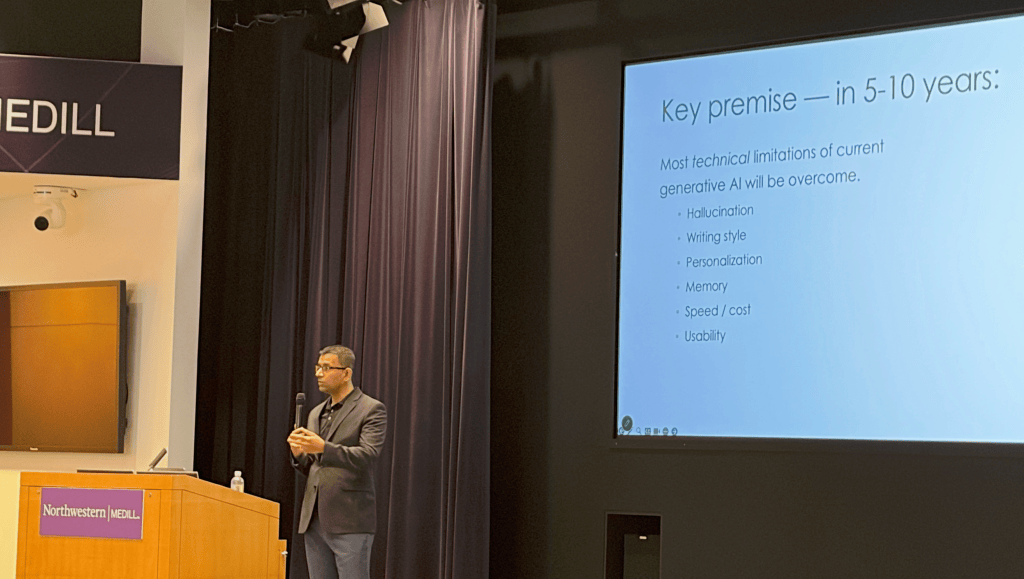
Arvind Narayanan, a Princeton computer scientist, predicts that AI chatbots will become more accurate and trusted, potentially serving as a “truth oracle.” A Pew survey found 10% of Americans already treat chatbots as such. At a Northwestern symposium, Narayanan argued that AI could replace newsrooms as the primary source for factual information, shifting journalism toward storytelling and analysis. He warned of the risks of AI’s “view from nowhere” and criticized media’s role in amplifying polarization. Narayanan also called for a political movement to protect journalism’s future.
Our Reading
The announcement sounds familiar.
Narayanan predicts AI will replace newsrooms as fact-checkers.
He warns of AI’s false neutrality and media’s role in polarization.
Journalism may shift to storytelling and analysis.
The numbers tell one story: AI is reshaping truth and trust.
Author: Evan Null
The oracle and the slop
Narayanan argues that AI chatbots are evolving beyond simple language models into neurosymbolic systems, capable of searching the web, retrieving documents, and analyzing data. He notes that errors like miscounting letters in “strawberry” are now rare, suggesting the remaining issues are gradually being solved. He compares the shift to how Wikipedia transformed from an untrusted source to an authoritative one, suggesting a similar trajectory for AI.
He also points out that some users, particularly conservatives, already use AI tools like Grok to settle arguments, indicating a growing reliance on AI for factual answers. Narayanan estimates this shift could take about a decade, though he remains cautious about whether it’s inevitable or beneficial.
The idea of AI as a “truth oracle” raises concerns about its neutrality. Narayanan acknowledges the risk of AI perpetuating a “view from nowhere,” where it avoids taking a stance, much like some journalists. He says this is a challenge for journalism to address as it evolves.
He also critiques the media’s role in amplifying polarization, citing research that shows efforts to set the agenda in the Trump era may have worsened trust in news. This suggests a broader shift in how truth and authority are perceived in the digital age.
Narayanan’s views reflect a growing debate about AI’s role in shaping public discourse and the future of journalism. As AI becomes more integrated into daily life, the question of who controls the narrative becomes increasingly urgent.
The unbundling
Narayanan argues that the traditional newsroom model is becoming obsolete, as specialized entities now perform individual functions more efficiently. He draws parallels to historical shifts, such as the rise of trade reporting and the move of local journalism to a philanthropy-funded model. This suggests a return to earlier patterns of news production, where different entities handle different aspects of the process.
He also points to the role of AI in further unbundling the news industry, making it possible for small teams to produce high-quality content. This shift challenges the notion that journalism is solely the domain of large news organizations, suggesting a more decentralized future.
Narayanan’s analysis highlights the economic forces driving these changes, including the rise of independent journalists, social media creators, and AI tools. He argues that the traditional newsroom model is no longer the most economically viable way to produce news, signaling a fundamental transformation in the industry.
His framework is rooted in historical debates about the role of newspapers and the need for journalism as a public good. He references thinkers like Clay Shirky and Paul Starr, who have long argued that the survival of journalism depends on new models of funding and production.
The unbundling of journalism reflects a broader trend in the digital age, where technology is reshaping not only how news is produced but also who controls the narrative. As traditional models decline, new actors and structures are emerging to fill the gap.
Who pays
Narayanan highlights a growing power imbalance between AI companies and news publishers, where the latter rely more on the former for distribution. He argues that this dynamic leads to underpriced journalism, as AI firms have less incentive to pay fair value for content. This creates a structural challenge for the sustainability of quality journalism.
He cites the “pivot to video” as an example of how algorithmic changes by tech companies can force news organizations to adapt, often at a disadvantage. This illustrates the broader issue of power asymmetry in the digital ecosystem, where tech companies wield significant influence over content distribution.
Narayanan suggests that journalists need to form a political movement to advocate for their interests, potentially including taxes on AI and social media companies. He emphasizes the need for broad-based support to avoid perceptions of partisanship and ensure the survival of quality journalism.
His call for democratic input into AI algorithm tuning reflects a growing concern about the role of technology in shaping public discourse. He envisions a future where journalists have a seat at the table in decisions that affect the news landscape, similar to oversight boards in other tech platforms.
The challenge for journalism is not just to adapt to technological change but to reclaim agency in a rapidly evolving digital environment. As AI becomes more integrated into daily life, the question of who controls the narrative becomes increasingly urgent.