Source: Fortune.com
Summary
Nvidia reported second-quarter revenue of $96.2 billion, up 106% year-over-year and exceeding analyst estimates. The company also forecast 70% revenue growth for fiscal 2028, higher than analyst expectations. Data center revenue reached $89 billion, with hyperscale and AI cloud segments driving the majority of the growth. Nvidia’s non-GAAP earnings per share also surpassed expectations. Shares rose after an initial decline following the report.
Our Reading
The numbers tell one story.
Nvidia’s Q2 revenue more than doubled year-over-year.
Its 2028 growth forecast outpaces analyst estimates.
Data center revenue dominates the company’s AI business.
Executives frame AI as a revenue engine, not just a trend.
Author: Evan Null
Key Financials
Nvidia’s second-quarter revenue reached $96.2 billion, a 106% increase from the previous year. This figure exceeded analyst expectations of $92.2 billion. The company also reported a 18% increase from the previous quarter, highlighting consistent growth in its AI chip business.
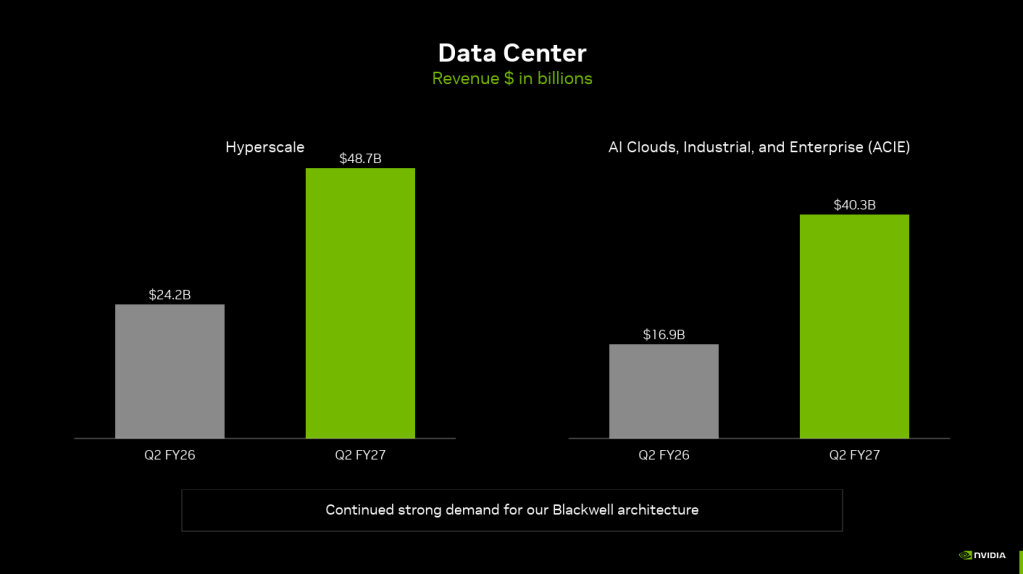
The data center segment, which is the core of Nvidia’s AI revenue, generated $89 billion in sales. This outperformed analyst estimates of $85.7 billion. Within the data center division, hyperscale revenue reached $48.7 billion, while AI clouds, industrial, and enterprise (ACIE) revenue totaled $40.3 billion.
Nvidia’s non-GAAP earnings per share were $2.22, surpassing the expected range of $2.06 to $2.09. This marks a significant increase from the previous quarter, when non-GAAP earnings were $1.87 per share.
The company’s guidance for the current quarter forecasts revenue of $91 billion, plus or minus 2%, which is below the average analyst expectation of $103.9 billion. Despite this, shares rose more than 5% in after-hours trading.
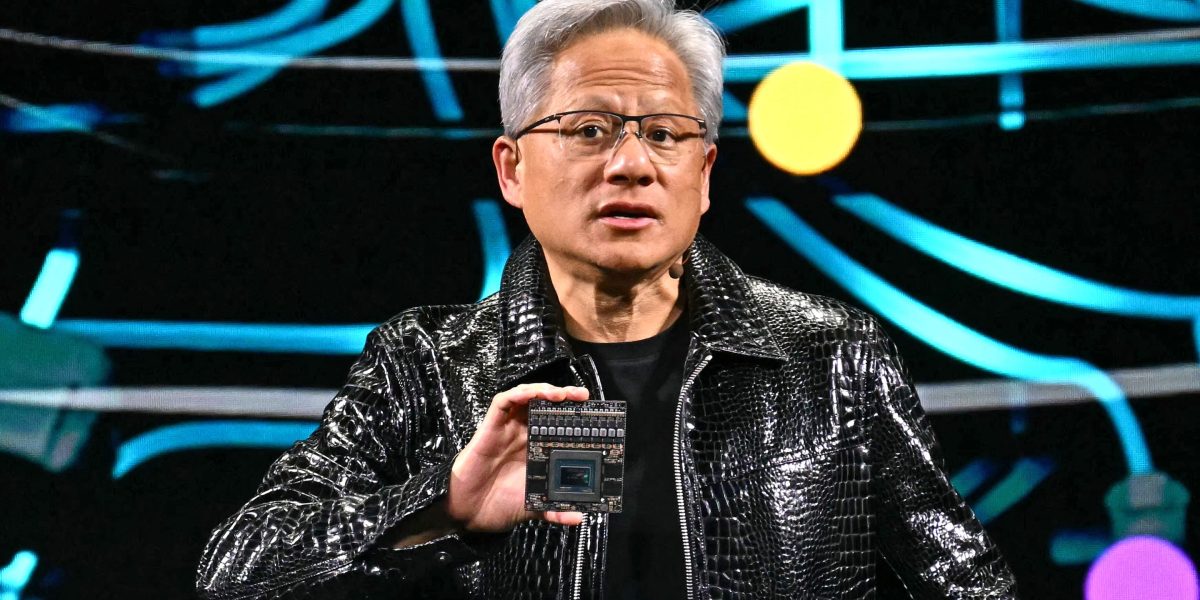
Nvidia’s CEO, Jensen Huang, emphasized that AI has reached an inflection point, with compute now directly translating into revenue. The company’s outlook for fiscal 2028 includes a 70% growth rate, far exceeding the 44% growth expected by analysts.
Market Reaction
Nvidia’s stock initially declined after the earnings report but quickly reversed course, rising over 5% in after-hours trading. This suggests that investors are reacting positively to the company’s strong performance and forward-looking guidance.
The stock movement highlights the volatility often seen in tech stocks, especially those with high growth expectations. Despite the initial dip, the market appears to be confident in Nvidia’s ability to sustain its momentum.
Analysts have been closely watching Nvidia’s performance as the company continues to dominate the AI chip market. The recent results reinforce its position as a key player in the industry, with demand for its products showing no signs of slowing down.
The company’s decision to provide a long-term growth forecast for fiscal 2028 is a rare move, indicating confidence in the continued demand for its AI solutions. This forecast could influence investor sentiment and set the tone for future expectations.
While the current quarter’s guidance is below analyst expectations, the long-term outlook remains strong. This suggests that Nvidia is positioning itself for sustained growth, even as it navigates the challenges of a rapidly evolving market.
Strategic Shifts
Nvidia has begun to break down its data center revenue into two segments: hyperscale and AI clouds, industrial, and enterprise (ACIE). This move allows the company to better differentiate between large cloud customers and other AI-driven segments.
The company’s shift in reporting reflects a broader strategy to provide more transparency and clarity to investors. By separating these revenue streams, Nvidia can highlight the performance of different parts of its business more effectively.
This change in reporting may also help the company address concerns about its reliance on a few major cloud customers. By showing distinct figures for hyperscale and ACIE, Nvidia can demonstrate a more balanced revenue base.
Despite the shift, the data center segment remains the largest driver of Nvidia’s revenue. The company continues to benefit from the growing demand for AI infrastructure, which is fueling its expansion into new markets.
The company’s focus on AI and compute solutions is a clear indicator of its long-term strategy. As AI becomes more embedded in various industries, Nvidia is positioning itself to capture a larger share of the market.
Industry Context
Nvidia’s performance comes at a time when demand for AI chips is surging across multiple industries. The company has positioned itself as a leader in this space, with its GPUs being used in everything from data centers to autonomous vehicles.
The AI market is expanding rapidly, and companies are increasingly relying on specialized hardware to power their machine learning and deep learning applications. Nvidia’s chips are at the forefront of this trend, giving the company a competitive edge.
As more companies adopt AI technologies, the demand for high-performance computing solutions is expected to grow. This trend is likely to benefit Nvidia in the long term, as it continues to develop new products and technologies.
However, the company also faces competition from other tech firms that are investing heavily in AI. Companies like Intel, AMD, and Google are also working on their own AI solutions, which could challenge Nvidia’s market position in the future.
Despite the competition, Nvidia’s strong financial results and forward-looking guidance suggest that the company is well-positioned to maintain its leadership in the AI chip market. Its ability to adapt to changing market conditions will be critical in sustaining its growth.
Executive Commentary
Jensen Huang, CEO of Nvidia, emphasized that AI has reached a critical inflection point, with compute now directly translating into revenue. His comments reflect the company’s confidence in the long-term potential of AI and its ability to generate consistent earnings.
Huang’s statement that “demand is accelerating” highlights the company’s belief in the continued growth of the AI market. This sentiment is echoed in Nvidia’s forward-looking guidance, which forecasts a 70% increase in revenue for fiscal 2028.
The CEO’s remarks also suggest that Nvidia is not just a hardware provider but a key player in the broader AI ecosystem. By positioning itself as a revenue-generating force, the company is reinforcing its value proposition to investors and customers alike.
While Huang’s comments are positive, they also reflect the challenges of maintaining growth in a rapidly evolving market. The company must continue to innovate and adapt to stay ahead of the competition.
Overall, the CEO’s message is one of confidence and optimism, which aligns with the company’s strong financial performance and forward-looking strategy. His leadership is seen as a key factor in Nvidia’s continued success in the AI space.