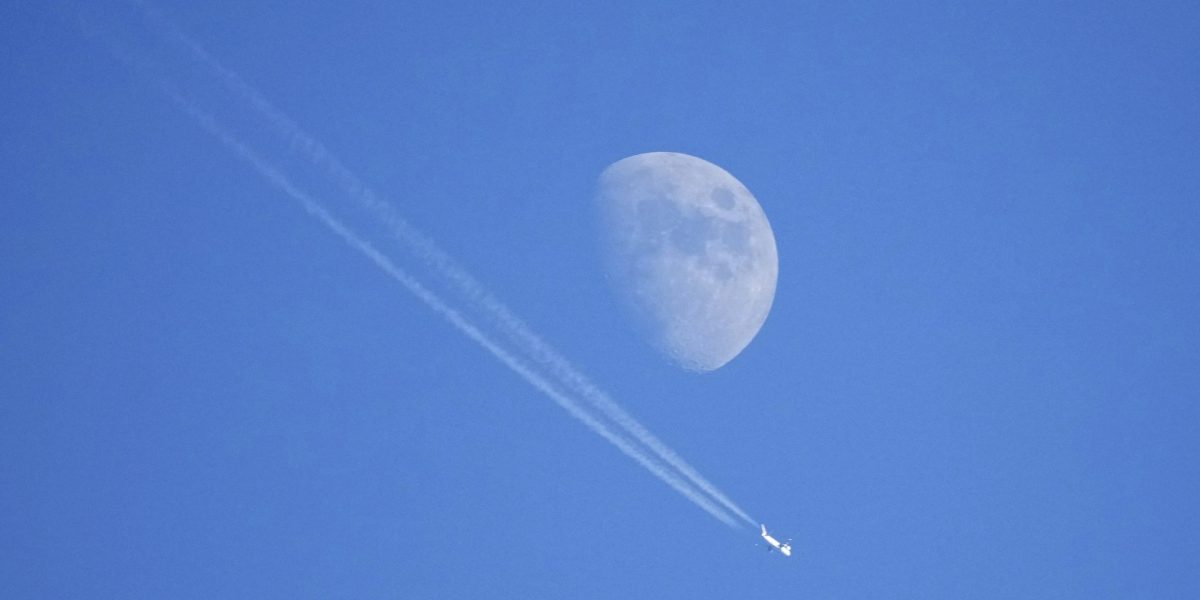
Source: Fortune
Summary
The British government and Google are launching a two-year trial to reduce aviation’s climate impact by adjusting flight altitudes to avoid contrail formation. The program, called Operation Blue Skies, will test minor altitude changes in the Shanwick Oceanic Control Area, a busy air corridor between Europe and North America. Google’s AI will help identify areas where contrails are likely to form. The trial will involve hundreds of flights over two winters, with adjustments of up to 2,000 feet. The goal is to demonstrate a statistically significant reduction in contrail formation on an airspace scale. The project is funded in part by the UK government and includes research partners like the Met Office and Imperial College London.
Our Reading
The numbers tell one story.
The UK government is funding a $6.76 million study to test flight path changes.
Google’s AI will help identify contrail-prone areas.
Hundreds of flights will adjust altitudes to avoid cloud formation.
The trial aims to reduce aviation’s climate impact on a large scale.
The strategy enters a familiar phase: tech and government collaboration on climate solutions.
Author: Evan Null
Background of the Initiative
The initiative, known as Operation Blue Skies, is a collaboration between the British government, Google, and several research institutions. It aims to address the environmental impact of contrails, which are formed when aircraft fly through cold and humid air. These contrails can trap heat and contribute to global warming. The trial is set to take place over two winters in the Shanwick Oceanic Control Area, a key route for transatlantic flights. The goal is to determine whether small altitude changes can significantly reduce contrail formation without disrupting regular flight operations.
Role of Google and AI
Google is playing a central role in the initiative by providing its AI-powered forecasting tools to identify areas where contrails are likely to form. This technology will help air traffic controllers make informed decisions about flight path adjustments. Paul Hodgson, Google’s technical lead for the project, emphasized that even a small percentage of flights changing altitude could lead to a measurable reduction in contrail formation. The AI’s ability to predict contrail formation is a key component of the trial’s success.
Government and Funding
The UK government is contributing more than half of the £5 million ($6.76 million) budget for the study. This investment highlights the government’s commitment to finding practical solutions for reducing aviation’s environmental impact. Keir Mather, the UK minister responsible for aviation, stated that the project supports British experts and innovators in developing cleaner flying methods. The government’s involvement underscores the growing importance of public-private partnerships in addressing climate challenges.
Previous Research and Testing
This initiative builds on previous research and testing by individual airlines. For example, American Airlines and Google previously collaborated to reduce the climate impact of certain flights using AI-based forecasting. The new trial expands on these efforts by testing altitude adjustments across an entire flight corridor rather than on a single airline’s routes. This larger-scale approach is expected to provide more comprehensive data on the effectiveness of contrail mitigation strategies.
Scientific and Environmental Implications
Contrails are responsible for a significant portion of aviation’s climate impact, with some estimates suggesting they contribute 1% to 2% of global warming. The Shanwick airspace alone accounts for about 5% of contrail-related warming. The trial aims to test whether small altitude changes can reduce this impact on a large scale. Researchers from institutions like Imperial College London and the University of Cambridge are involved in the project, which is seen as a major step forward in aviation climate research.