Source: Fortune.com
Summary
Chinese humanoid robots broke human athletic records, including Usain Bolt’s 100-meter sprint and the high jump record, at the World Humanoid Robot Games in Beijing. The event, featuring over 2,000 robots, included 51 competitions such as running, table tennis, and soccer. Organizers said the games highlight China’s advancements in robotics as it competes with the U.S. The U.S. has imposed restrictions on Chinese robotics, citing national security concerns. Experts note that humanoid robots are still primarily used for demonstrations and research, though their capabilities are rapidly improving.
Our Reading
The numbers tell one story.
Chinese robots beat human records in sprint and high jump.
2,000 robots competed in 51 events.
U.S. banned imports of Chinese humanoid robots.
China claims majority of global humanoid robots.
Experts say robots are still mostly for demos and research.
Author: Evan Null
Chinese Robots Break Human Records
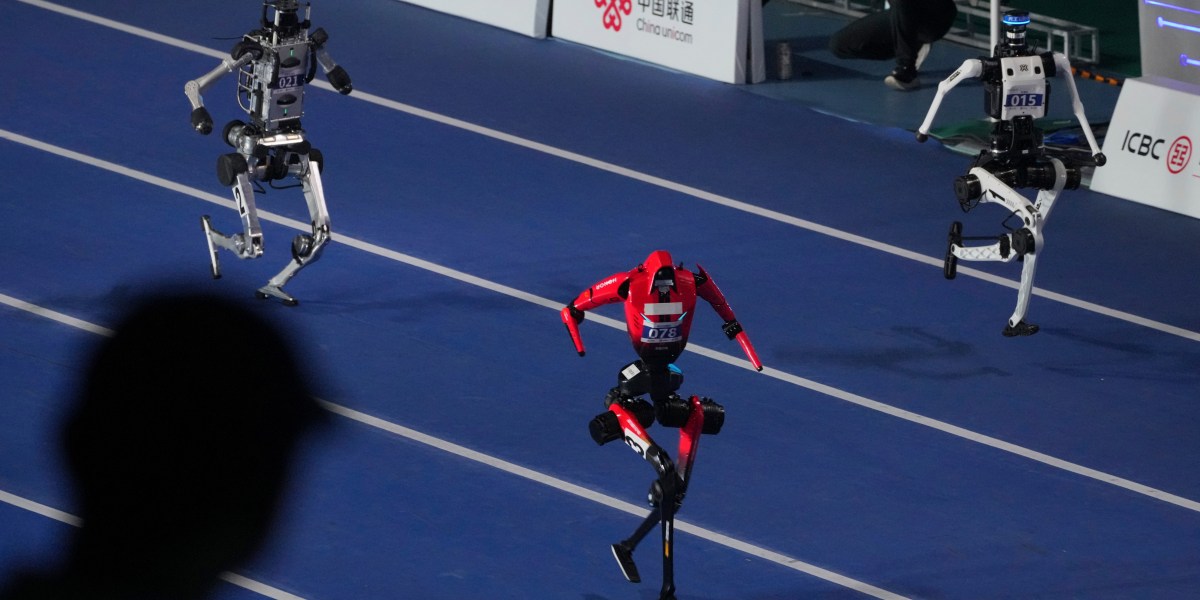
At the World Humanoid Robot Games in Beijing, Chinese robots set new records, including beating Usain Bolt’s 100-meter sprint time. The event, which featured over 2,000 robots, highlighted China’s rapid progress in robotics. The games took place in the National Speed Skating Oval, a venue built for the 2022 Winter Olympics. This year’s event included 51 competitions, such as running, table tennis, and soccer, with robots from 16 countries participating.
U.S. Restrictions on Chinese Robotics
The U.S. has taken steps to limit the import of Chinese humanoid robots, citing national security concerns. The Federal Communications Commission recently announced a ban on new foreign-made humanoid robots, targeting China. The Pentagon also added a leading Chinese robot maker, Unitree, to a list of companies with alleged military ties. Beijing has denied these accusations and continues to promote its robotics industry.
Record-Breaking Performances
During the games, a humanoid robot from Beijing-based X-Humanoid achieved a 100-meter sprint time of 9.39 seconds, surpassing Bolt’s 9.58-second record. Another robot set a high jump of 2.88 meters, exceeding the human record of 2.45 meters. A robot from the smartphone company Honor also set a 100-meter sprint record of 9.32 seconds during a trial. These performances showcased the growing capabilities of Chinese robotics.
Public Reaction and Expert Views
Some spectators expressed excitement about the rapid progress of humanoid robots. Li Yanfeng, an education worker, said she initially resisted AI but now sees its development as unstoppable. Yang Shangzheng, another spectator, called the robot performances “perfectly normal for humans, but now robots can do them.” Experts, however, note that humanoid robots are still mostly used for demonstrations and research, with mass real-world deployment still in the future.
Global Participation and Future Goals
This year’s robot games included participants from 16 countries, including Germany, Japan, and the U.S. The event also featured competitions like weightlifting and tug of war. Organizers emphasized the games as a platform to showcase China’s technological advancements in robotics. As the U.S. and China continue their technology race, the development of humanoid robots remains a key area of focus and competition.