Source: Fortune
Summary
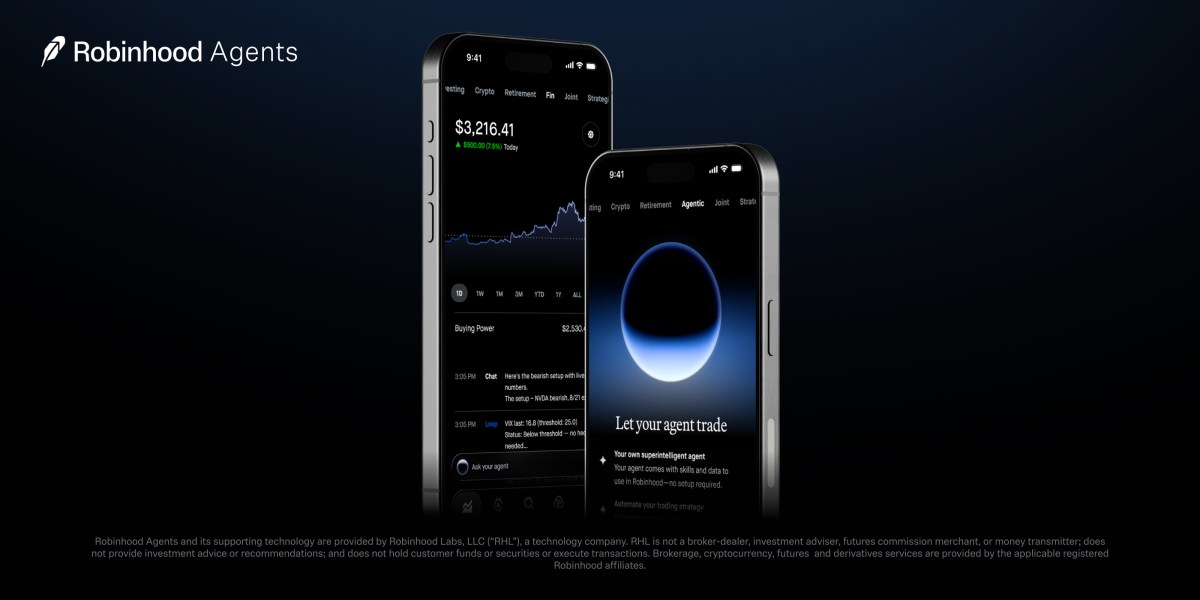
Rocketing into the future, Robinhood is rolling out AI-powered trading agents to all 29 million of its users. The agents, built on OpenAI and Anthropic models, allow customers to issue plain English commands for trading, research, and strategy building. The feature was announced during the HOOD summit and follows a May tool that let technical users connect their own agents. Robinhood claims the agents will give retail investors tools similar to those used by Wall Street. The company also added guardrails, like trade limits and approval steps, to prevent unexpected behavior. The move could reshape how Americans invest and impact market dynamics.
Our Reading
The numbers tell one story.
Rocketing into the future, Robinhood is rolling out AI-powered trading agents to all 29 million of its users.
The agents, built on OpenAI and Anthropic models, allow customers to issue plain English commands for trading, research, and strategy building.
The feature was announced during the HOOD summit and follows a May tool that let technical users connect their own agents.
It’s a step toward democratizing finance, but also a step into uncharted territory.
Author: Evan Null
A New Frontier of Investing
Rocketing into the future, Robinhood is rolling out AI-powered trading agents to all 29 million of its users. The agents, built on OpenAI and Anthropic models, allow customers to issue plain English commands for trading, research, and strategy building. The feature was announced during the HOOD summit and follows a May tool that let technical users connect their own agents. Robinhood claims the agents will give retail investors tools similar to those used by Wall Street. The company also added guardrails, like trade limits and approval steps, to prevent unexpected behavior. The move could reshape how Americans invest and impact market dynamics.
Democratizing Finance
In conversations with Fortune, Robinhood executives made the case that access to easy-to-use agents, as well as libraries of financial data, will provide users with investing tools comparable to the ones used by Wall Street. If this is the case, the arrival of Robinhood Agents amounts to another milestone in the company’s self-proclaimed mission to democratize finance. “Ownership doesn’t work without markets, and markets don’t work without traders,” said Robinhood CEO Vlad Tenev in a statement. “We’re making Robinhood the best place in the world for active traders by delivering tools once reserved for hedge funds, big banks, and quant firms.”
Unpredictable Market Changes
The mass release of trading agents has the potential to change investment patterns in unpredictable ways. That could include a major uptick in the volume of active trading on exchanges or the emergence of new trading strategies. It’s possible to imagine hypothetical future scenarios that are less rosy. For instance, what if trading agents begin to confer with one another, and move en masse into or out of a given asset? Such a scenario could, in turn, introduce greater volatility into the market or even outright panic if they involve malicious actors.
Legal and Financial Uncertainties
In the event that something does go wrong with agent-based trading, it’s unclear where any legal liability would fall. Robinhood’s view is that hosting agents does not amount to providing financial advice and that, when it comes to any suggestions they provide or actions they undertake, the situation is akin to the customers asking the internet or a friend. Like so much with AI, however, the legal landscape around agentic trading is still evolving. There is also the question of how much customers end up spending to operate their trading agents.
Early Adoption and Future Prospects
There are early signs that the agents will be used. According to Robinhood, over 150,000 customers have already opened agentic accounts by using the more technical version of the tool the company introduced this spring. And as of late September, various agents are transacting on Robinhood’s platform nearly 30 million times a day. While Robinhood is for now the only brokerage to offer nontechnical agents at scale, other fintech and crypto firms—including eToro, Public, and Coinbase—currently let their users connect their agents via MCP tools. It is a likely bet that these firms will soon roll out trading agents directly within their own platforms, and that, in time, conventional brokerages like Schwab and Fidelity will do the same.